
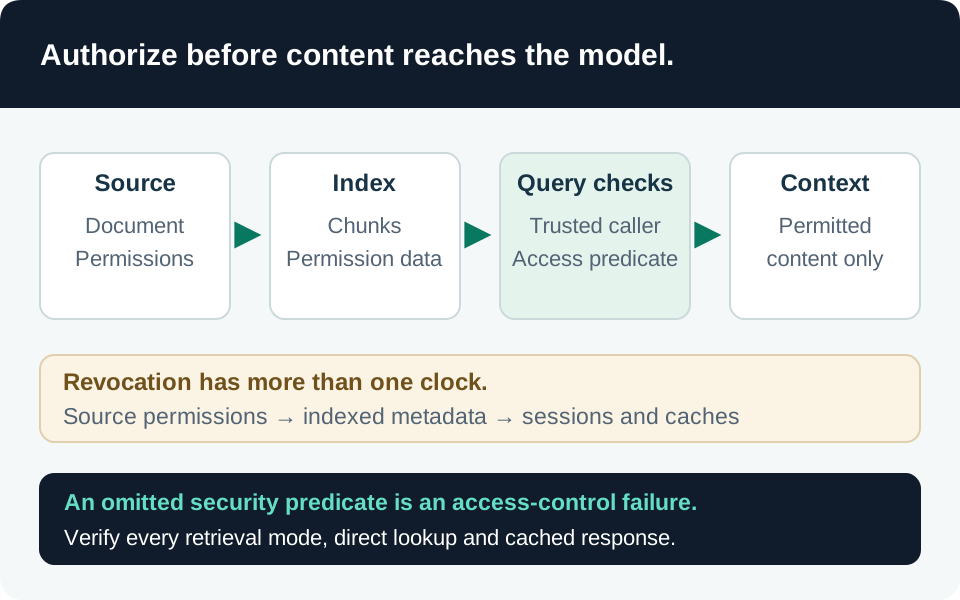
A retrieval service can enforce document permissions correctly while its underlying storage still permits a broader reader, an account key, or an unexpired download link to bypass the application. Secure the source, staging, and export stores as separate data systems. This guide focuses on Blob Storage and Data Lake workloads; do not extend its conclusions automatically to Azure Files or other services.
Draw the data paths, including temporary copies
Inventory upload containers, parser work areas, rejected documents, model evaluation corpora, exports, backups, and recovery accounts. Record where an object can move and which identity performs each operation. A temporary staging container often contains the same sensitive content as the serving corpus, even if its retention is shorter.
Our recommended authority split gives ingestion permission to write approved input locations, a serving identity read access only where required, and a separate recovery identity access to restoration functions. Avoid granting the model-facing runtime authority to change source permissions or destroy every copy of its grounding data. Apply the same review to tool-generated files and downloadable reports.
Blob data roles can be scoped to a container. Portal browsing with Entra credentials also needs an appropriate management-plane read role; that browsing requirement is different from the data permission itself. Blob role scopes.
Close alternate authorization paths deliberately
Microsoft recommends Entra authorization, including managed identities where supported. Account access keys represent broad authority and can also sign SAS credentials. An application migration is incomplete while an old key remains usable by another integration. Storage authorization models.
For Blob workloads, setting allowSharedKeyAccess to false rejects Shared Key and account-key-signed SAS requests. A user delegation SAS follows a different authorization path and can remain valid. A null setting permits Shared Key; it is not an implicit deny. Storage’s SAS log classification does not identify which SAS type was used. Shared Key enforcement.
Before enforcement, identify every legitimate integration and run representative reads, writes, list operations, and recovery jobs using Entra authentication. Keep a change-specific rollback procedure, but do not retain a hidden key fallback inside the normal application. Monitor subsequent attempts to re-enable Shared Key and attempts that continue using it.
Disallow anonymous Blob access at the account level for private corpora. The account setting overrides container-level anonymous permissions. Verify the effective configuration and an actual unauthenticated request; an obscured object name is not an access control. Anonymous-access behavior.
Treat SAS as a transferable credential
A SAS can authorize whoever possesses it within its configured limits. Our issuance design binds a short-lived link to one intended object and only the required operation. Never return a container-wide write token because the frontend requests upload convenience. Strip SAS query parameters from application logs, browser error reports, analytics events, and incident screenshots.
Microsoft notes that individual SAS generation is not audited by Storage and that stored access policies are unsupported for user delegation SAS. Therefore, maintain an application issuance record if you need to connect a link to an approved business operation. Record recipient context, object identifier, allowed operation, expiry, and issuer—not the token. SAS design and limitations.
Test revocation against the specific credential mechanism. Do not claim that removing a user from an application session necessarily invalidates a previously issued download capability immediately. If rapid revocation is a requirement, use an authorization-aware download service or a verified short-lived capability design and document the remaining interval.
Validate network and object boundaries separately
A Storage private endpoint does not disable the public endpoint. Configure the public-network boundary explicitly. Data Lake operations can require both Blob and DFS private endpoints; providing only one can leave some operations failing. Clients should continue using the normal service hostname, with private DNS resolving the intended path. Storage private endpoint requirements.
A private network path does not prove object authorization. From an allowed network, test a principal that lacks the intended data role. From a disallowed network, test a principal that otherwise has valid credentials. These tests isolate the two controls instead of accepting any failure as proof of both.
Acceptance matrix and investigation evidence
| Scenario | Required result |
|---|---|
| Serving identity reads its approved container | Expected content is available |
| Same identity writes or deletes source data | Denied unless explicitly part of the design |
| Ingestion identity reads an unrelated tenant corpus | Denied by the storage boundary |
| Anonymous request and legacy account key | Rejected after the corresponding control is enabled |
| Narrow SAS used on another object or operation | Rejected without disclosing the token in logs |
| Blob and DFS operations over private networking | Both required paths work; public fallback is absent |
| Permission removal and previously issued access | Residual access interval is measured and recorded |
Collect resource-specific data-plane logs for the operations your detection strategy needs. Azure management activity does not substitute for object-read evidence. Interpret unsuccessful requests separately from successful transfers, and avoid treating SAS use as proof of Shared Key use. Finish by testing document authorization in retrieval and ingestion integrity against the same corpus.
Go to the source
References & further reading
- Microsoft Learn — Authorize access to Azure Storage data
- Microsoft Learn — Prevent Shared Key authorization
- Microsoft Learn — Shared access signature security and limitations
- Microsoft Learn — Assign an Azure role for Blob data access
- Microsoft Learn — Private endpoints for Azure Storage
- Microsoft Learn — Prevent anonymous Blob access