Microsoft fixed this vulnerability in its cloud service. There is no customer patch to install for CVE-2025-32711. The advisory describes an AI command-injection information-disclosure vulnerability and explicitly says that users need take no action. The controls below address continuing exposure to untrusted content and excessive access; they are not prerequisites for receiving that fix. Microsoft advisory.
Scope and evidence timeline
This dossier concerns the historical Microsoft 365 Copilot issue. It does not establish that Copilot Personal, GitHub Copilot, a custom Azure AI application or every product carrying the Copilot name shared the flaw. It also does not establish exploitation in your organization.
| Date | What the source establishes |
|---|---|
| June 11, 2025 | Microsoft published the CVE with the service already mitigated. |
| December 17, 2025 | Microsoft’s security article described EchoLeak as fixed and characterized the disclosure as limited data already accessible to the victim, under particular conditions. |
| February 20, 2026 | Microsoft’s CVRF history records an informational CWE update, not a new customer patch. |
| November 13, 2026 | This documentation review checked those sources and current defensive controls; it did not test a tenant. |
The advisory’s historical exploitation assessment is not a statement about all activity since publication. Keep the original observation date when importing advisory fields into an incident record. Microsoft CVRF history, Microsoft’s later assessment.
The boundary that failed
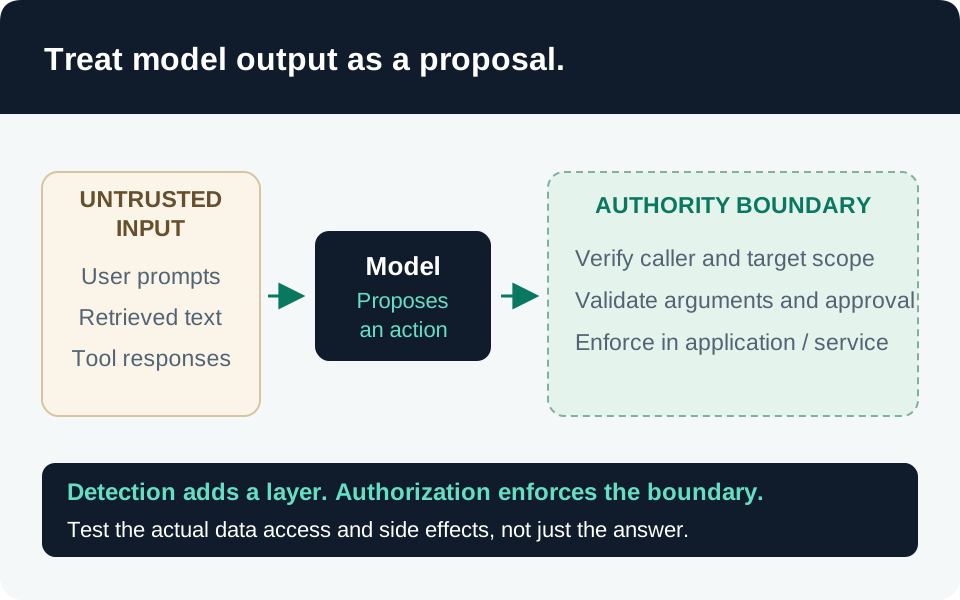
Aim Labs described an indirect prompt-injection chain: attacker-controlled email became context for the assistant, and instructions embedded in that lower-trust content influenced processing of higher-trust information. The research combined failures in instruction filtering and permitted output/network behavior. Reading malicious text as an instruction is the significant boundary crossing; possessing a legitimate mailbox or document permission does not make an external sender authoritative. Original Aim Labs research, now hosted by Cato.
Our defensive model separates three questions: may the user read the information, may the assistant use it for this task, and may the resulting information leave through this destination? A successful authentication answers none of the latter two automatically. Reviewing only the prompt typed by the user misses material retrieved afterwards. Conversely, a broad permission inventory alone cannot prove that this historical vulnerability was exercised.
Prioritize controls with measurable owners
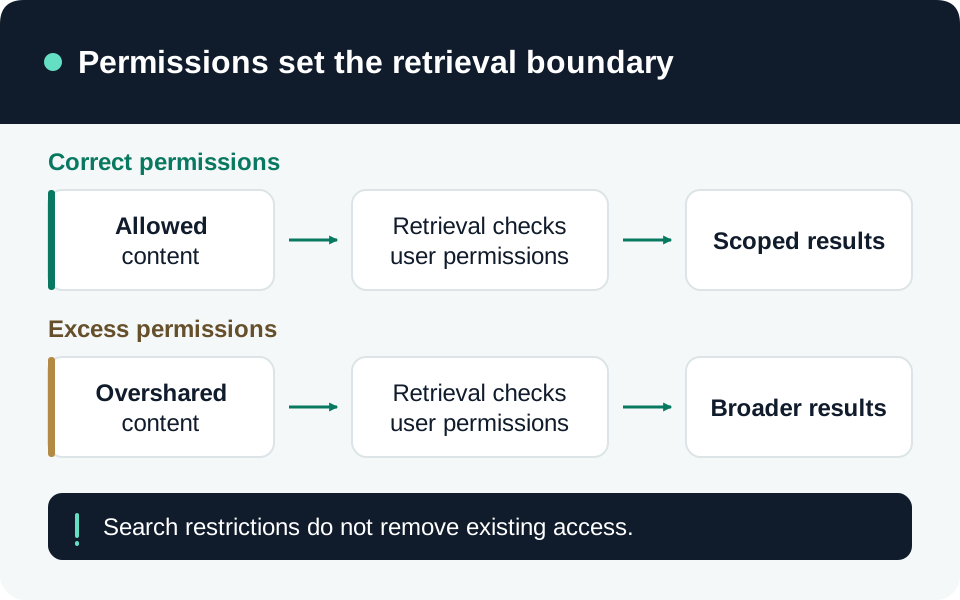
First, correct the accessible data set. Ask information owners to identify sensitive sites, shared mailboxes, broad groups and anonymous links. Test effective access with ordinary pilot identities, including a user outside the intended audience. Remove unjustified grants at the resource; record discovery restrictions separately from access restrictions. Microsoft’s architecture guidance distinguishes those boundaries. Copilot data controls.
Our suggested work item contains the resource identifier, owner, intended audience, actual audience, exception expiry and a negative-access test. Start with secrets, regulated information and commercially sensitive material. Track unresolved exposure by owner and business impact, rather than by whether one Copilot answer happened to omit a document.
Second, evaluate external-email grounding. Current Purview documentation includes a preview control for Microsoft 365 Copilot and Copilot Chat that excludes email from external senders from grounding, summarization and citations. It compares sender metadata with accepted domains; it does not inspect message bodies or remove the user’s access to the message. Cowork is not supported for this control. Verify availability and licensing, pilot the business impact, and include accepted-domain maintenance in the review. External-email DLP scope.
Treat an internal sender as a routing fact, not a guarantee of trustworthy instructions. Our recommended pilot includes forwarded material and an internally authored synthetic document containing an instruction unrelated to the user’s task. Those checks evaluate policy behavior and residual risk; they do not reproduce EchoLeak.
Third, test content protection by path. Label-based DLP can prevent processing while leaving a citation. Prompt-sensitive-information checks do not scan directly uploaded file contents. These are different coverage boundaries. Use synthetic examples to validate each path and record propagation time before accepting the result. Copilot DLP limitations.
Build evidence before an investigation
Microsoft documents that Purview Audit records interaction identity, context and referenced resources, but not prompt or response text. Authorized eDiscovery or DSPM for AI access is needed for content review; retention policies govern the stored interactions. Audit and content locations.
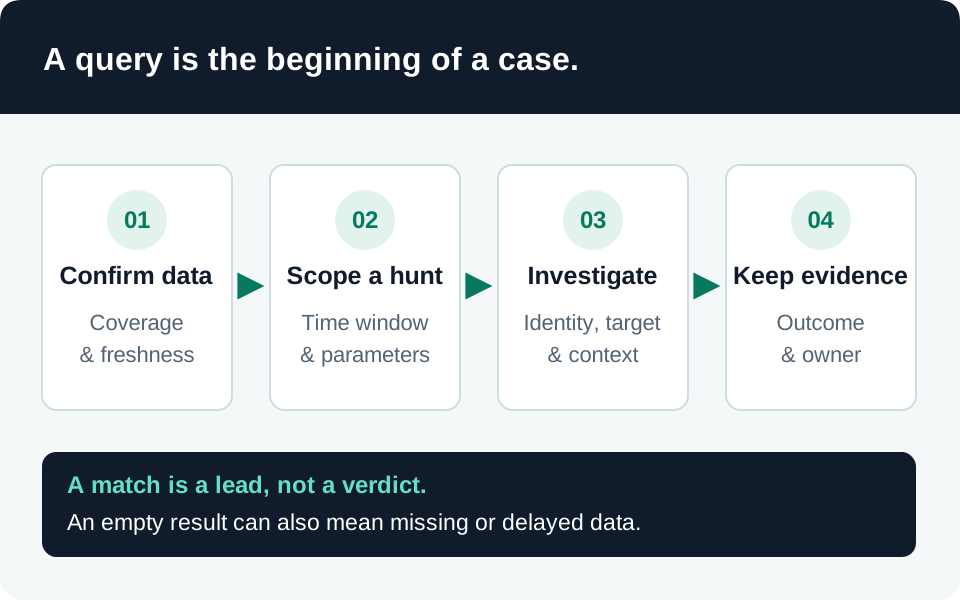
Our recommended evidence map records which mailbox, audit source, message trace, endpoint or network source can answer each investigation question, its actual retention period, and who can export it. Measure collection latency using a harmless interaction. A Sentinel query cannot recover events that expired or were never collected; absence of an alert is not an exposure assessment.
The linked Copilot inventory and volume queries help establish activity and identify review candidates. They are not EchoLeak signatures. An unusual volume can be legitimate, and a low-volume disclosure can avoid a volume threshold. Preserve original identifiers and timestamps before correlating email arrival with later Copilot interactions; temporal proximity alone does not establish causation.
Validate controls and rehearse recovery
Use test identities and synthetic content. The following is a proposed acceptance matrix, not a report of executed tests.
| Check | Expected evidence | Escalation condition |
|---|---|---|
| Unauthorized reader | Direct access denied; no protected content returned | An unintended grant or protected answer |
| External-email restriction | External test email excluded in supported experiences | Inclusion after verified policy propagation |
| Label restriction | Processing outcome recorded separately from citation | Restricted content appears in the answer |
| Upload path | Documented coverage gap and compensating handling rule | Team assumes prompt scanning covers file bodies |
| Investigation readiness | Authorized analyst retrieves audit and retained synthetic interaction | Missing access, collection or retention |
For a credible disclosure report, preserve the original email, relevant interaction, resource versions and time zone before removing material. Identify what was actually accessible and what evidence shows it was transmitted; do not classify every accessible file as confirmed exfiltration. Quarantine suspicious content through the approved mail process, reduce unnecessary access, and rotate any secret shown to have escaped. Escalate a suspected new service defect to Microsoft with a sanitized reproduction and evidence references.
Close the case when containment has been verified, affected data owners have assessed impact, and each collection gap has an assigned remedy. Keep vendor remediation, local hardening and incident conclusions as separate records so a completed cloud fix cannot be mistaken for a completed tenant investigation.
Trace the evidence
Primary intelligence & product guidance
- Microsoft Security Response Center — CVE-2025-32711 ↗
- Microsoft Security Response Center — June 2025 CVRF advisory data ↗
- Aim Labs / Cato Networks — Breaking down EchoLeak ↗
- Microsoft — AI Application Security Series 1 ↗
- Microsoft Learn — Data protection and auditing for Microsoft Copilot ↗
- Microsoft Learn — DLP for Microsoft 365 Copilot ↗