Assumptions to confirm
- One enterprise Microsoft Entra tenant; cross-tenant subsidiaries require a separate design decision.
- Initial workloads operate in one approved Azure region; a second region is selected only against business recovery requirements.
- Production and nonproduction use separate application subscriptions with nonoverlapping address spaces.
- The example workload uses Azure compute with managed identity, Blob Storage and Key Vault private endpoints.
- The organization can fund shared network services, appropriate identity licensing and an operated monitoring platform.
This reference design gives several application teams a common Azure foundation while keeping the authority to change that foundation separate from application delivery. It is a documentation-reviewed design, not a deployed or tenant-tested environment. Every acceptance result below must be produced in the adopting organization.
Use case and decision boundary
The first workload is an internal document-processing application: compute reads approved Blob Storage data, obtains secrets from Key Vault where identity authentication is unavailable, and emits operational and security events. The foundation also accommodates later AI workloads, but does not imply that every Foundry service, agent tool or external model endpoint inherits the same networking capabilities.
Before provisioning, record permitted regions, information classifications, recovery time and recovery point objectives, expected application count, support hours and the identity licenses already held. A second region, customer-managed encryption keys and Premium firewall inspection are decisions with owners and operating costs, not automatic markers of enterprise readiness.
Tenant, hierarchy and subscription boundaries
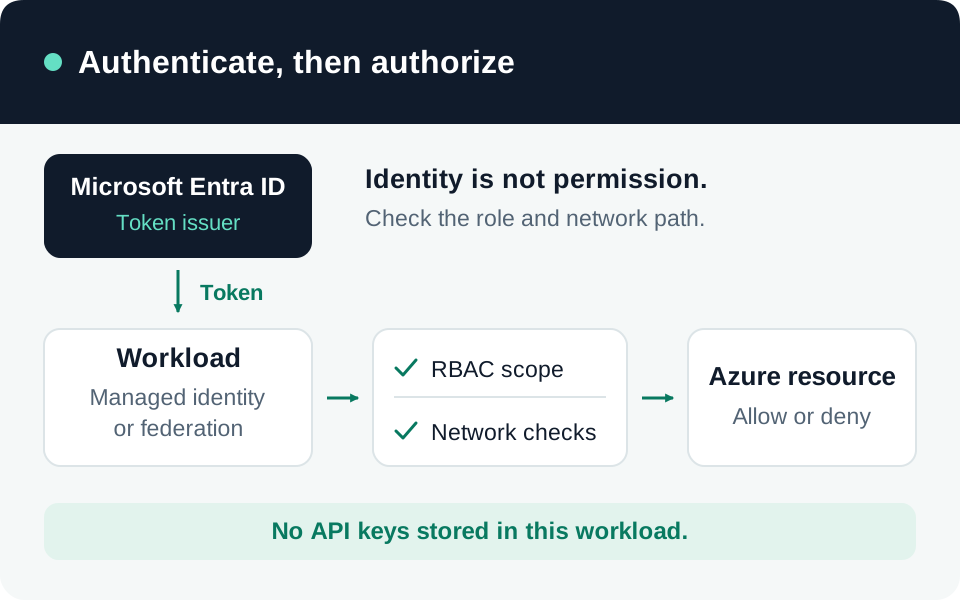
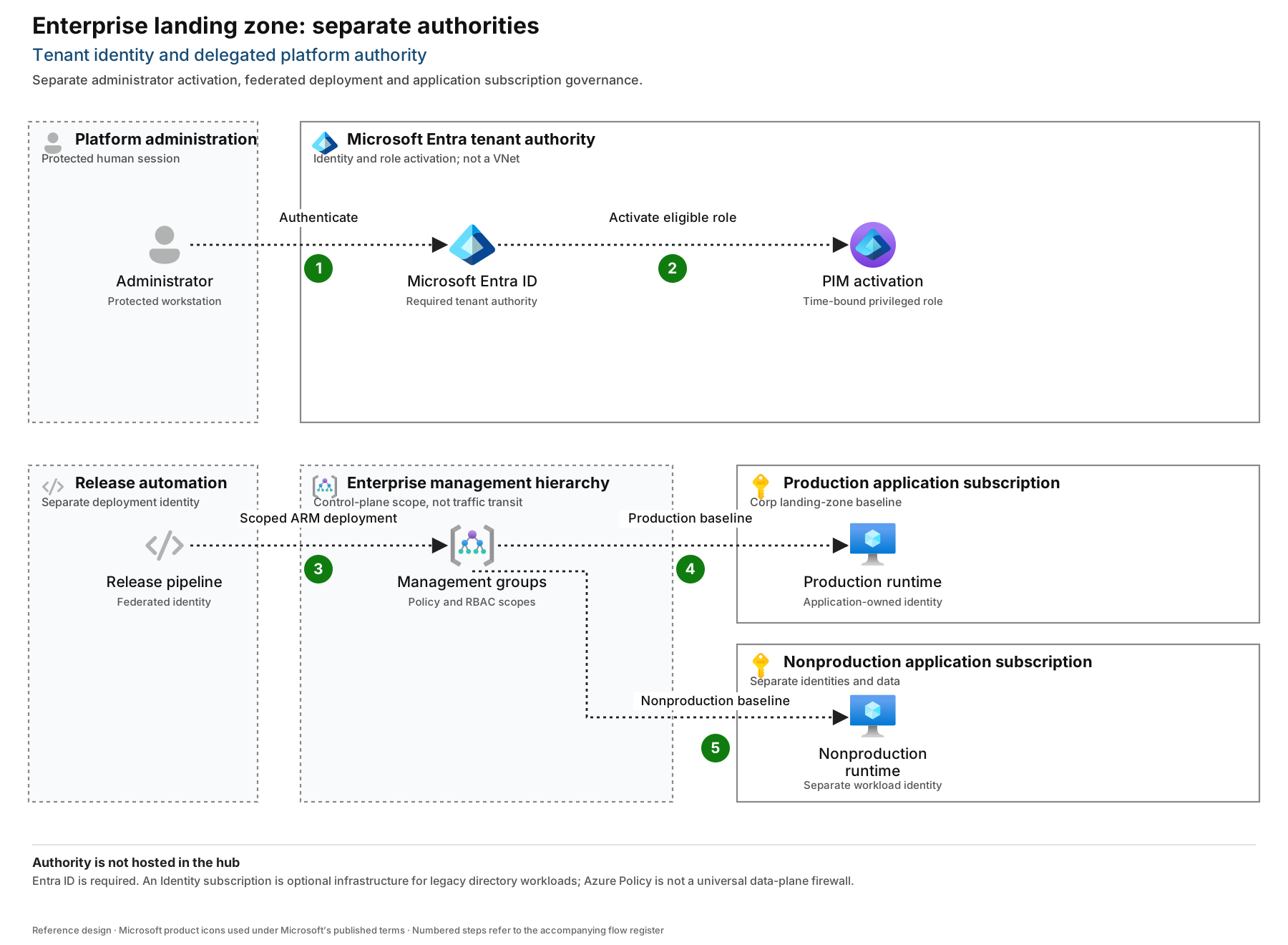
Microsoft Entra ID is the required identity authority associated with the subscriptions. It is not hosted in the hub VNet or the optional Identity subscription. That subscription is for resources such as Windows Server domain controllers when applications actually require them. Cloud-native managed identities do not create that requirement. Subscription design.
Under the tenant root management group, create an enterprise intermediate root. Its children are Platform, Landing zones, Sandbox and Decommissioned. Under Platform, separate Connectivity, Management, Security and, if needed, Identity. Under Landing zones, use Corp and Online archetypes for different connectivity and policy requirements. Place production and nonproduction subscriptions under the appropriate archetype; do not mirror every department or region into the hierarchy. Keep broad root assignments minimal and restrict hierarchy changes. Management-group guidance.
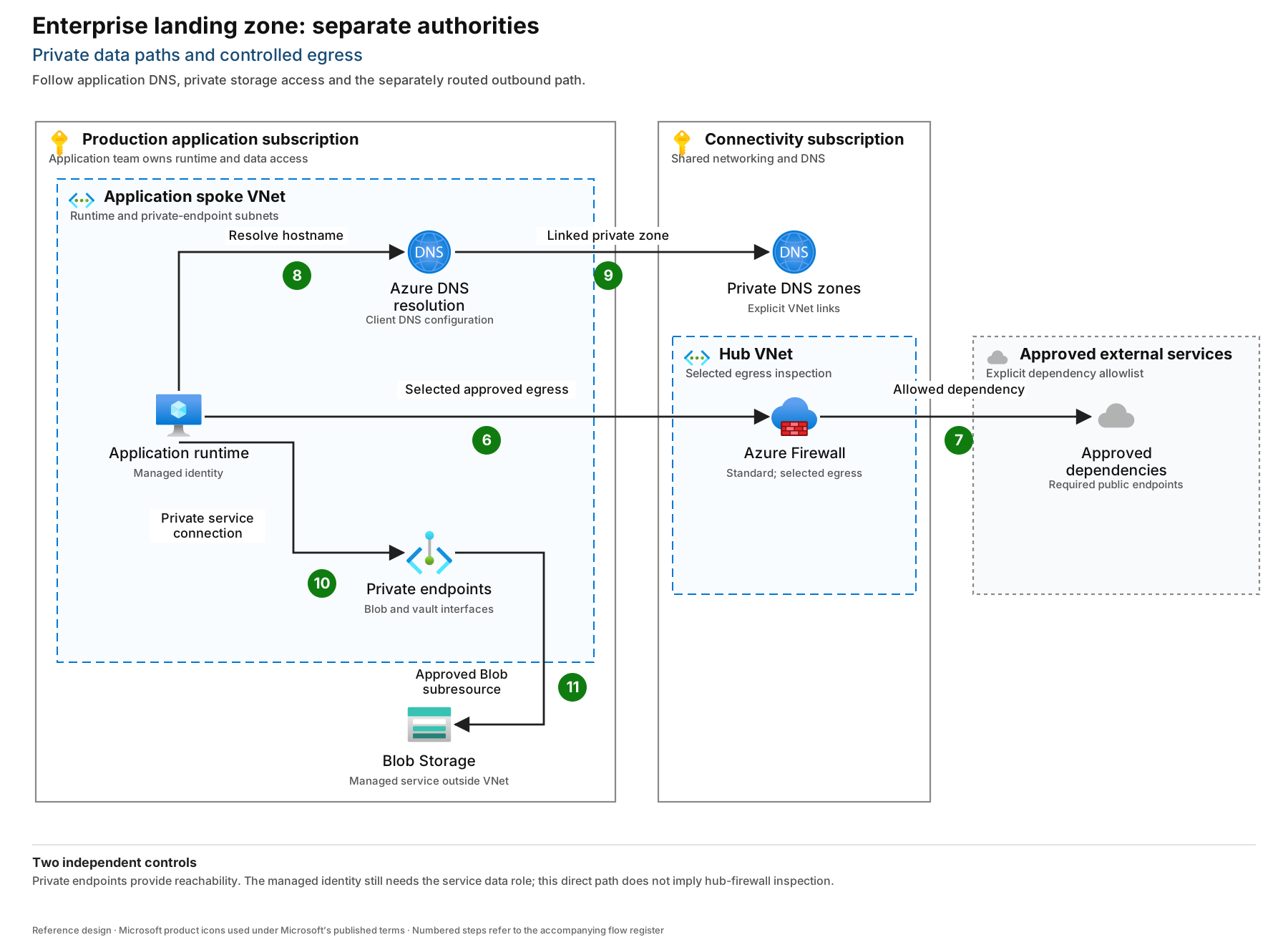
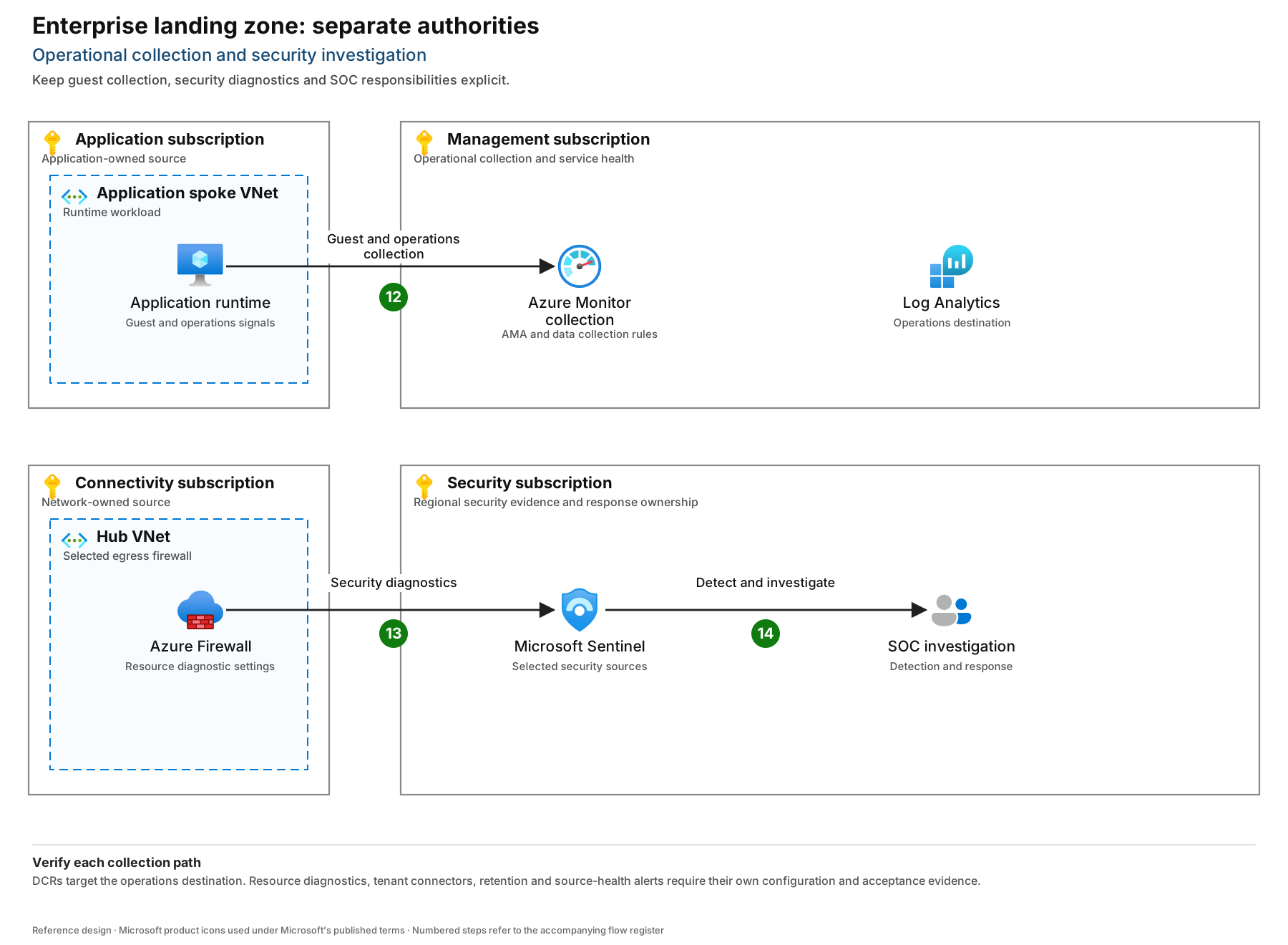
The three views separate private data paths, platform authority and operational/security collection. The identity view includes two Corp application subscriptions. Sandbox and Decommissioned remain governance branches, not paths through the network hub. A subscription boundary separates administration, quotas and billing; it does not automatically prevent peering, role assignment or data access between applications.
Component and control matrix
| Boundary | Selected component | Owner and enforceable responsibility |
|---|---|---|
| Tenant identity | Entra ID, Conditional Access, PIM | Identity team controls administrative authentication, eligible roles and emergency access. |
| Enterprise hierarchy | Management groups and Azure Policy | Platform governance controls subscription placement, allowed configuration and approved exceptions. |
| Connectivity subscription | Hub VNet, Azure Firewall, shared DNS | Network team owns address allocation, routes, firewall rules and private-zone integration. |
| Management subscription | Operations Log Analytics, Azure Monitor, DCRs | Operations team owns service health, guest collection and operational alert delivery. |
| Security subscription | Sentinel-enabled Log Analytics workspace | SOC owns security connector configuration, detection, investigation and evidence access. |
| Optional Identity subscription | AD DS domain controllers and supporting network | Identity team owns directory recovery and legacy authentication dependencies, when required. |
| Application subscription | Compute, managed identity, private endpoints, Storage and Key Vault | Application team owns application authorization, data protection, dependencies and restoration. |
The separate operations and security workspaces are a proposed ownership model. Route a record to the destination that needs it; avoid duplicating all telemetry into both. Organizations with a shared operations/SOC ownership model can evaluate fewer workspaces while retaining the same access and retention requirements.
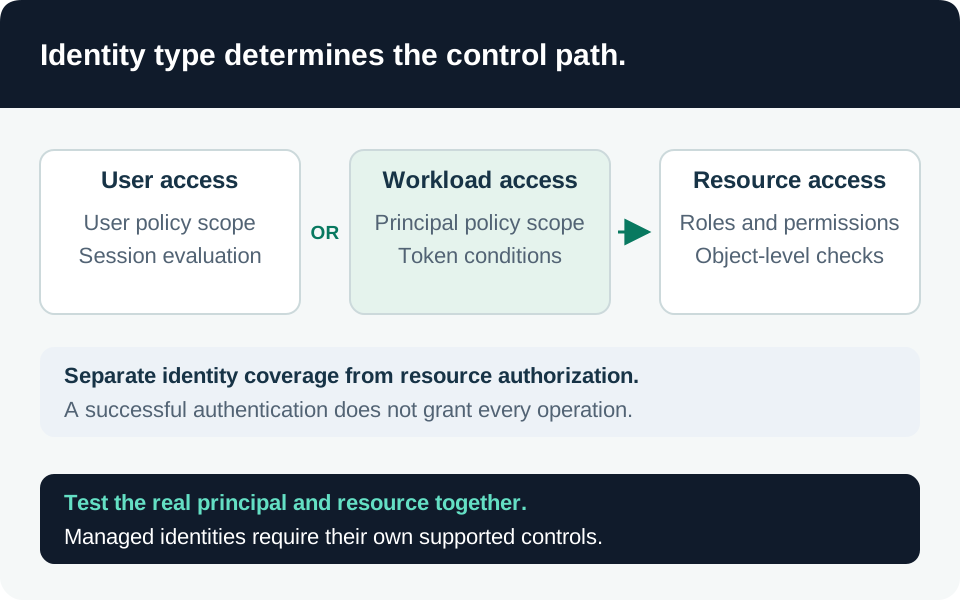
Identity and policy are distinct controls
Use separate groups for platform administrators, subscription operators, application deployers and SOC readers. Make powerful human roles eligible through PIM, with short activation windows and an auditable approval path. Verify the required Entra ID P2 or ID Governance licensing for the affected users. Keep tested emergency access outside a dependency chain that the same failed policy could disable. PIM licensing.
Vending automation assigns application teams permissions at their subscription or resource-group boundary. A federated deployment identity receives only the roles needed for its release; it must not become a standing tenant or management-group administrator. Give the runtime a separate managed identity with resource-specific data permissions. Platform deployment and application data access should remain separate even when both use automated credentials. Landing-zone identity guidance.
Start policy assignments in audit, measure the effect on real deployment plans, and then enforce approved restrictions. Policy can constrain resource configuration and deploy supported settings; it is not a universal packet filter or substitute for a service’s data-plane authorization. Existing noncompliance also needs an explicit remediation owner and change window. Azure Policy scope.
Ordered identity, network and evidence flows
- F1–F2: administrative identity. An administrator authenticates to Entra and activates an eligible PIM role before changing platform configuration. Record the actual assignment scope; a successful sign-in alone does not demonstrate authorization.
- F3: deployment authority. The release workflow exchanges a federated identity assertion and invokes Azure Resource Manager within its assigned scope. The control-plane flow is separate from application traffic.
- F4–F5: subscription governance. The enterprise hierarchy applies the selected policy and RBAC baseline to production and nonproduction. Vending captures budget ownership, region choices, telemetry destinations and exception expiry.
- F6–F7: approved outbound traffic. Workload routes direct selected outbound traffic through Azure Firewall. Use explicit egress configuration rather than depending on implicit outbound access. The baseline uses Standard; choose Premium only when required TLS inspection or IDPS justifies certificate operations and additional cost. Outbound access, Firewall features.
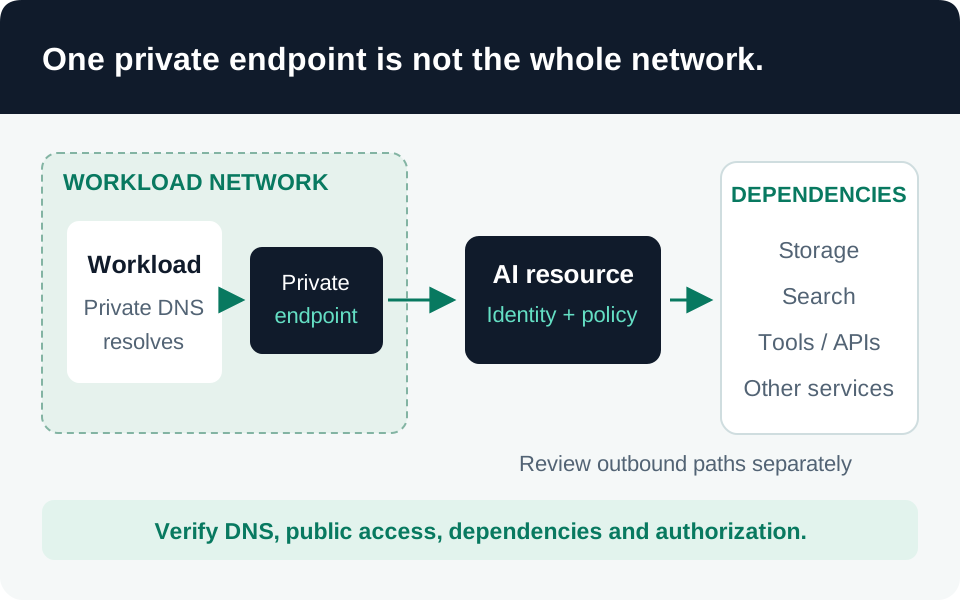
- F8–F9: name resolution. The illustrated cloud-only workload uses Azure-provided DNS and linked private zones. A shared resolver is reserved for hybrid conditional forwarding; it is not needed merely because a private endpoint exists. Zone links must be explicit; VNet peering does not supply DNS configuration. Private DNS integration.
- F10–F11: private data access. The runtime uses the normal service hostname and the private endpoint address. The endpoint NIC is in the VNet; Storage and Key Vault remain managed services outside it. Disable public network access where required and separately test the managed identity’s data permissions.
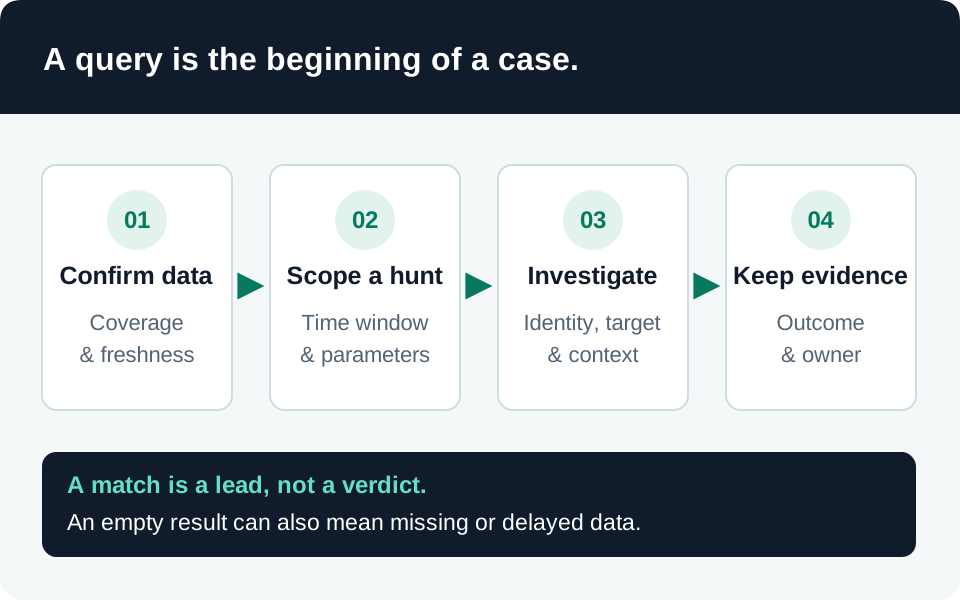
- F12–F14: evidence collection. Resource diagnostics and selected security events go to the SOC destination; guest and operational signals go to the operations destination. Workspace access is separately authorized. The SOC investigates observed events rather than assuming every network request becomes a Sentinel alert.
Monitoring scope and service constraints
Maintain a source register: resource ID, enabled categories, destination, expected table, owner, retention and heartbeat test. Export subscription Activity Logs. Enable the required service resource logs explicitly; they are not collected by default. Guest operating-system collection uses Azure Monitor Agent and data collection rules, a different path from resource diagnostic settings. Diagnostic settings, DCR model.
Use VNet flow logs where supported and justify their retention by investigation needs; they describe network flows, not application payloads or user intent. Private endpoint traffic and platform services require checking the documented coverage limits. VNet flow logs.
A Sentinel workspace belongs to a region. Select an approved geography, review processing exceptions, and split workspaces when sovereignty or ownership requires it. Native Microsoft/Azure SaaS collection also has tenant boundaries; a central workspace does not silently ingest every subsidiary tenant. Document connector-specific cross-tenant arrangements separately. Sentinel workspace boundaries.
Before choosing sizes, verify regional service availability, zone support, quota and capacity. Specify the compute SKU from workload measurements. Azure Firewall Standard supplies DNS proxy; Premium adds capabilities such as TLS inspection and IDPS, which still require routing and policy configuration. Key Vault, storage redundancy and private endpoint subresources must follow the application’s actual features and recovery requirements.
Threat tests and release acceptance
| Authorized test | Required result and retained evidence |
|---|---|
| Application deployer attempts to change a shared hub route | Denied authorization, with the tested identity and resource scope recorded. |
| Nonproduction identity requests production data | Service authorization denies access even when network reachability exists. |
| Internet client contacts a private-only data service | Public data access fails; a successful DNS response is not treated as access. |
| Runtime reaches an unapproved outbound destination | Expected deny is observed on the intended path, including return routing. |
| Operator changes a diagnostic setting in a test subscription | Management event reaches the agreed destination and the alert reaches an accountable responder. |
| Collector stops sending a synthetic expected event | Ingestion-silence monitoring distinguishes missing telemetry from a quiet workload. |
Run these tests with non-sensitive fixtures. Record timestamps, identities, normal service hostnames, effective routes and query results so the evidence can be repeated after a policy or network change.
Rollout, recovery and cost ownership
Roll out in this order: approve the hierarchy and role model; establish platform subscriptions and telemetry destinations; deploy DNS and explicit egress; vend a nonproduction application subscription; execute the threat tests; restore application data into an isolated environment; then admit production. Require a signed exception for each failed control instead of describing a partially configured subscription as compliant.
Keep infrastructure definitions, policy versions and DNS ownership records recoverable outside the subscription being restored. Rebuilding a VNet does not restore storage data, tenant identity or application secrets. The application owner proves data restoration; network operations proves DNS and route reconstruction; the identity team proves emergency access; the SOC proves evidence access during the incident. Test these dependencies in the chosen recovery region before assigning a recovery commitment.
Costs are driven by firewall uptime and processing, resolver endpoints, private endpoints, compute, log ingestion and retention, security plans, backups and any duplicated region. Share genuinely common services, apply per-source retention, and use measured usage before committing to capacity tiers. A smaller foundation can omit legacy directory infrastructure and unnecessary hybrid DNS endpoints; it cannot omit ownership, access testing or evidence collection and retain the same assurance.
Trace the design decisions
Microsoft architecture & product guidance
- Microsoft Learn — Management groups in Azure landing zones ↗
- Microsoft Learn — Subscriptions in Azure landing zones ↗
- Microsoft Learn — Identity and access management for application landing zones ↗
- Microsoft Learn — Microsoft Entra ID Governance licensing ↗
- Microsoft Learn — Azure Policy overview ↗
- Microsoft Learn — Azure Firewall feature comparison ↗
- Microsoft Learn — Default outbound access in Azure ↗
- Microsoft Learn — Azure Private Endpoint DNS integration ↗
- Microsoft Learn — Azure Monitor diagnostic settings ↗
- Microsoft Learn — Data collection rules in Azure Monitor ↗
- Microsoft Learn — Sentinel workspaces and tenant boundaries ↗
- Microsoft Learn — Virtual network flow logs ↗