
Cloud control planeKQL
Advanced huntFind management callers absent from the previous seven days
Compare successful recent Azure management callers with a separate historical window, scoped by subscription and normalized caller identifier.
Detection engineering
Readable Sentinel queries for identity, cloud changes and Copilot activity. Understand the signal, tune the scope, and investigate the result.
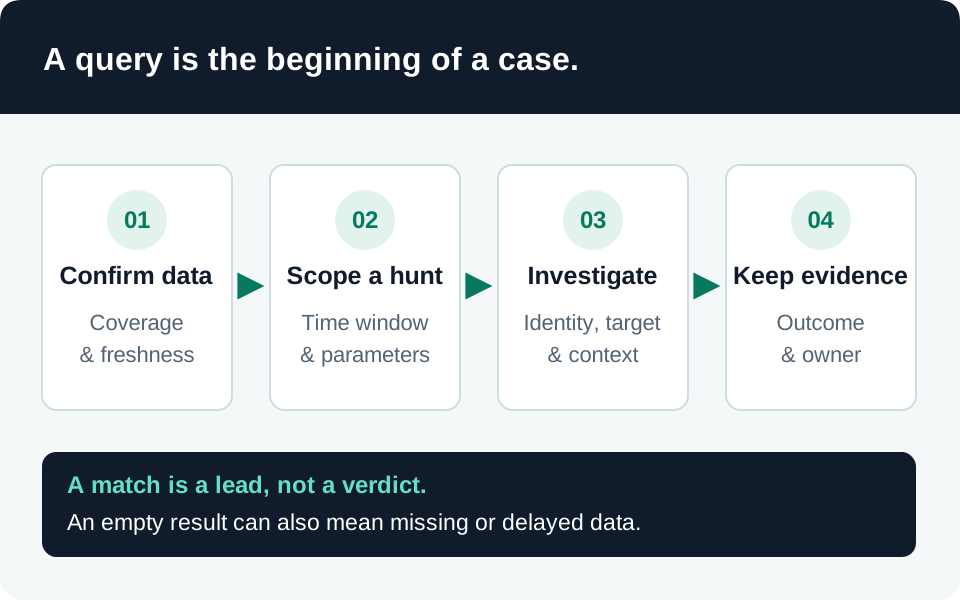
These are documentation-checked hunting starters. They have not been executed against your tenant and are not validated analytics rules. An empty result can mean missing data; a match is a lead to investigate.
Check your telemetry first →53 queries
Compare successful recent Azure management callers with a separate historical window, scoped by subscription and normalized caller identifier.
Find recorded Microsoft.CognitiveServices write operations and distinguish configuration activity from model inference.
Review successful lock mutations and identify the protected scope before assessing subsequent management changes or recovery risk.
Review recorded deployment and responsible-AI policy mutations under Cognitive Services accounts while separating management evidence from inference traffic.
Review successful assignment and exemption mutations with their resource scopes and initiating callers, then verify the effective policy outcome separately.
Inventory successful storage-account and private-endpoint connection mutations, then compare configuration evidence before claiming that network access was widened.
Inspect recorded role-assignment writes and deletes, preserving operation status, caller and correlation evidence.
Find recorded diagnostic-setting writes and deletions, retain operation outcomes, and investigate whether categories or destinations changed before declaring a logging gap.
Find recorded vault writes, deletions and access-policy updates, then verify whether identity, network or recovery controls actually changed.
Find recorded control-plane deletions, preserve caller and correlation evidence, and separate completed management operations from requests still in progress.
Anchor administrative activity to successful role-assignment changes by the same caller and subscription, without inferring activity by the grantee.
Identify Activity Log failures containing authorization or forbidden outcomes while acknowledging requests rejected before operation start are absent from this source.
Find large audit-volume changes for identified actors using equal UTC-day windows, a fixed 14-day denominator and an ingestion buffer.
Discover actual CopilotActivity workloads, normalized record types and host applications before writing behavioral hunts.
Identify tenant-qualified OAuth principals whose completed daily GetBlob volume exceeds a fixed historical average, retaining response-byte and object-diversity context.
Quantify AccountKey-authenticated Blob requests by resource, client and operation category while retaining outcomes and transfer context.
Compare tenant-qualified object identities accessing each vault with seven preceding days, keeping client applications and operation samples for investigation.
Review SAS request outcomes and expiry-policy evidence without exposing token-bearing URLs or assuming all SAS access uses the same signing authority.
Group HTTP 401 and 403 responses by vault, operation and caller evidence, retaining network and authorization context for troubleshooting.
Group successful DeleteBlob requests by account and caller evidence, retaining object samples while distinguishing request counts from permanent data destruction.
Group secret retrieval, cryptographic use, backup and destructive operations with HTTP outcomes, identity hints and affected-object evidence.
Separate successful anonymous reads from rejected requests, with sanitized object paths and response-size context rather than assuming every anonymous hit exposed data.
Rank successful SecretGet bursts by request count and approximate object diversity, with caller evidence and explicit limits on what volume can prove.
Expand failed policy results from interactive sign-ins and retain policy IDs, user populations and sign-in outcomes for investigation.
Find recent user/IP pairs absent from the preceding 14 days, requiring prior history for that user.
Join successful interactive sign-ins to preceding invalid-credential events for the same tenant, user and application within 30 minutes.
Compare successful application sign-ins with a separate 14-day source-IP baseline, excluding principals without previous history.
Require older successful history and no successful interactive events in the intervening 30-day window before flagging a recent return.
Compare managed-identity token activity with prior resource relationships while keeping workload attachment and downstream authorization as separate evidence.
Find source IP and application windows with invalid-credential failures across many resolved users, preserving the distinction between spray candidates and shared egress.
Compare successful workload resource identifiers against a prior baseline without treating token issuance as proof of new permissions or data access.
Map service-principal authentication to reported credential types, key IDs and federation IDs without exposing credential material.
Review sign-in outcomes for legacy client-app labels before changing authentication policy, including failures and unknown outcomes.
Keep home and resource tenant identifiers alongside the recorded cross-tenant access type when reviewing external access.
Compare reported authentication requirements by application and client while preserving the limits of MFA and policy interpretation.
Find failed managed-identity sign-in records without confusing token acquisition with downstream service authorization.
Separate background delegated authentication failures by user, application, resource and reported error without confusing them with workload identities.
Group failed interactive Entra sign-ins into 15-minute identity/IP windows for a bounded first-pass hunt.
Inspect Entra sign-ins carrying medium or high risk while preserving outcome and remediation context.
Group application identity sign-in failures by principal, resource, source IP and reported result.
Join credential additions to later successful sign-ins by directory and service-principal object ID without claiming the new credential was used.
Count distinct successful membership audit events per actor and 15-minute window, preserving raw target samples for group and member resolution.
Review successful policy creation, update and deletion with actor and raw before/after evidence instead of inferring weakening from a generic write.
Expand recorded application update properties and retain raw old/new values for review without assuming all fields have the same JSON shape.
Compare recent credential-management events with a separate seven-day actor/object baseline, retaining target type and change evidence.
Preserve initiator identity and every target's permission-change evidence for successful app-role, delegated-permission and consent events.
Inspect ownership additions and removals on application objects while preserving target relationships and distinguishing them from enterprise applications.
Separate direct, eligible, scoped and completed PIM role changes while retaining the full target payload for authoritative interpretation.
Track ownership changes on local service-principal objects without conflating them with the application's home registration.
Retain actor, target and changed-property evidence for successful authentication security-info updates without treating registration as account compromise.
Keep the latest observed record per provider-qualified alert identifier, rank declared severity and preserve event-time and entity-shape caveats.
Measure observed event-to-ingestion delay, timestamp gaps and empty sources across three security tables without treating missing data as healthy.
Find subscriptions and resource-log sources with sustained prior activity but no recent event-time rows, without treating quiet traffic as a proven ingestion outage.
Try a table name or choose all signals.
Build the investigation
Follow a structured path from data readiness to hunting, triage and response.