Assumptions to confirm
- A single Microsoft Entra tenant governs the platform and application subscriptions.
- On-premises, hub, DNS and spoke address spaces do not overlap; IPAM allocates future growth ranges.
- Two customer-edge devices terminate ExpressRoute connectivity; the backup VPN uses independent internet connectivity where feasible.
- Business owners accept a measured reduced service profile during VPN failover.
- The baseline uses one Azure region; regional recovery needs a separately prepared target and application data recovery.
- The workload uses Azure-provided DNS on its spoke and private endpoints for Blob Storage and Key Vault.
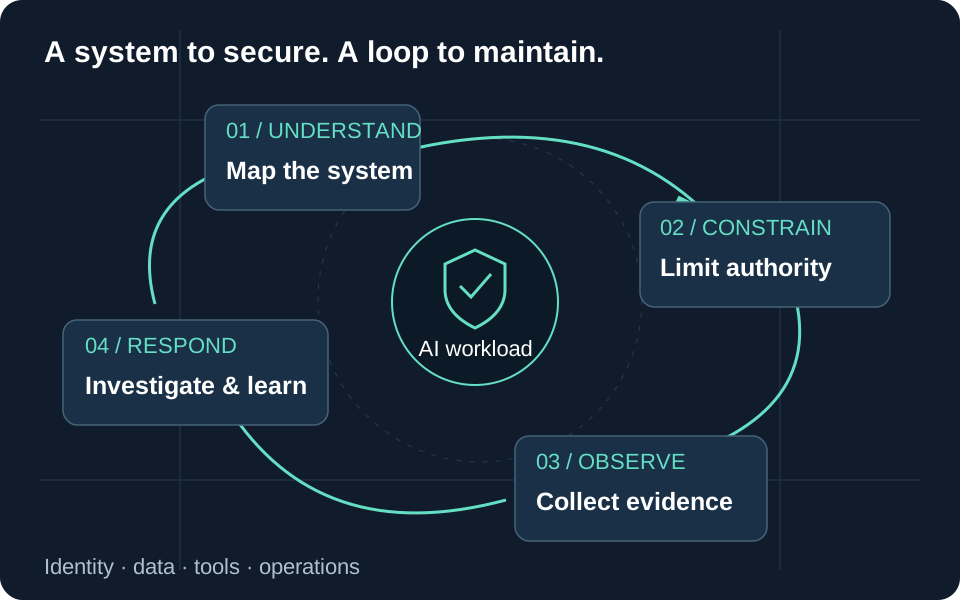
This design makes hybrid connectivity an explicit contract between network, DNS, identity and application owners. ExpressRoute, a firewall and a private endpoint solve different problems. Their presence does not demonstrate an inspected, authorized or recoverable end-to-end path. This is a documentation-reviewed reference, with no claim of testing in a customer tenant.
Use case and service contract
A datacenter application calls an Azure-hosted internal API and accesses approved Blob Storage data through a private endpoint. Azure workers also call a corporate service by DNS name. Production normally uses ExpressRoute private peering. VPN failover keeps a small set of essential transactions available; bulk ingestion pauses.
Before implementation, define the permitted source/destination prefixes, ports, identity requirements, throughput, latency, connection concurrency and degraded service list. ExpressRoute redundancy at one peering location does not remove location failure risk. If the business cannot accept VPN performance, use an appropriately resilient multi-location ExpressRoute design instead. Microsoft hybrid failover architecture.
Administrative and resource boundaries
Use the enterprise hierarchy described in the landing-zone foundation. The Connectivity subscription under Platform owns gateways, hub routing, Firewall and shared DNS. An application subscription under the Corp landing-zone archetype owns the spoke, runtime identity and private endpoints. Management owns operational collection; Security owns the Sentinel workspace and investigations.
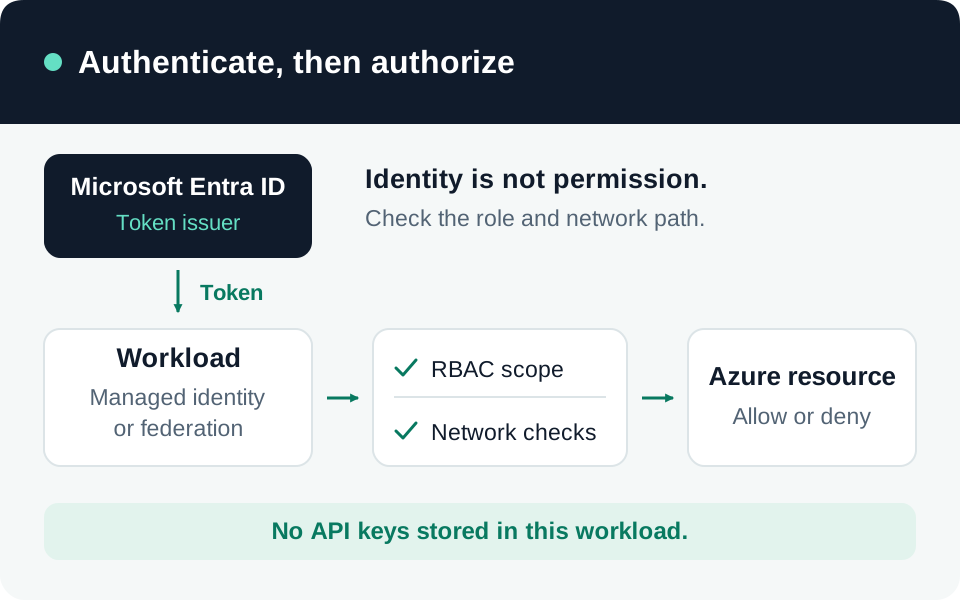
The Entra tenant is the shared identity authority, outside every VNet. PIM-controlled human roles govern changes to routes, peering, DNS zones and service access. Application deployers cannot edit the shared route policy. Runtime managed identities receive only the required data roles. An optional Identity subscription is needed only for directory workloads such as AD DS, not to provide Entra authentication.
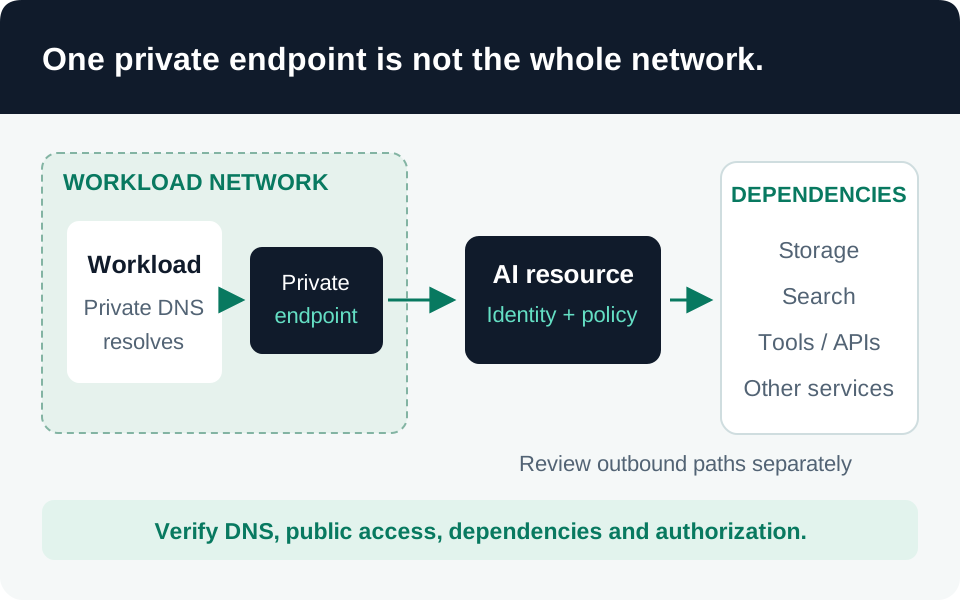
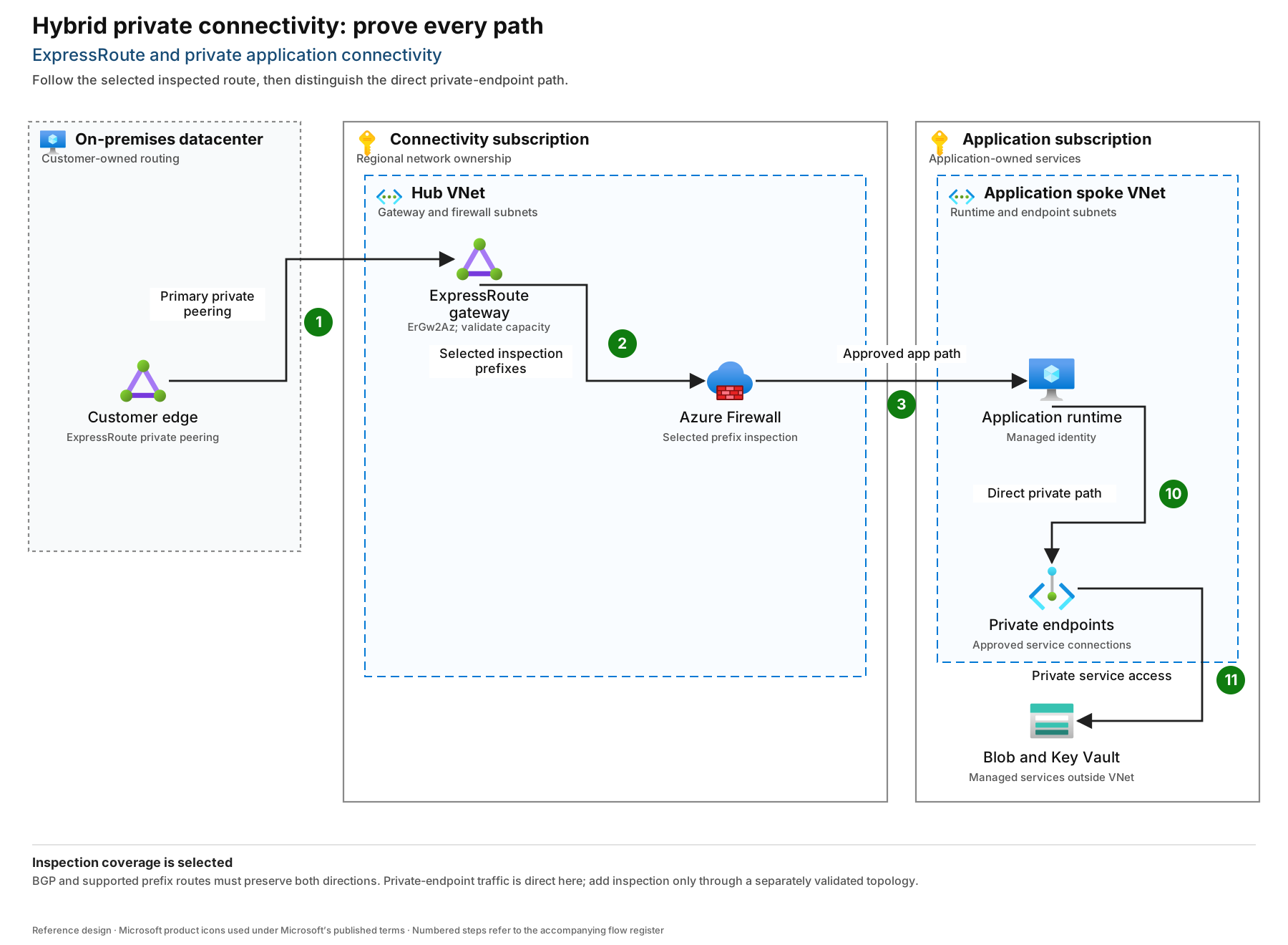
The connectivity view puts managed Storage and Key Vault resources outside the spoke’s VNet boundary. Their endpoint network interfaces are inside the private-endpoint subnet. Network reachability and data authorization remain separate acceptance tests.
Component and sizing decisions
| Component | Baseline choice | Constraint to verify before deployment |
|---|---|---|
| ExpressRoute | Private peering, redundant customer-edge connectivity, zone-capable gateway | Start capacity assessment with ErGw2Az; validate region, actual traffic and connection limits rather than treating a SKU as a guarantee. |
| Backup VPN | Route-based, BGP-enabled VpnGw2AZ, supported generation and Standard public IPs | Basic is unsuitable for ExpressRoute coexistence; benchmark real failover traffic and encryption overhead. |
| Gateway subnet | Dedicated GatewaySubnet with reserved growth capacity | Coexistence requires /27 or larger; this design reserves /26. Avoid unsupported NSGs and arbitrary default routes on it. |
| Selective inspection | Azure Firewall Standard with explicit prefix routes | Premium is a separate decision for IDPS/TLS inspection; neither SKU automatically sees every flow. |
| Hybrid DNS | DNS Private Resolver in a separate shared DNS VNet | Separate delegated subnets for inbound and outbound endpoints; this design reserves /26 each. |
| Private service access | Approved Blob and Key Vault private endpoints | Correct service subresources, private zones, public-access settings and caller roles are all necessary. |
The example gateway names are selection starting points, not a capacity commitment. Current VPN guidance favors AZ SKUs for new deployments; do not copy legacy non-AZ or dynamic-public-IP examples from older deployment snippets. VPN SKU guidance, coexistence requirements.
Keep ExpressRoute FastPath outside this baseline until its changed data path has been reviewed against inspection requirements. Check the selected gateway’s support before adopting it. The separate DNS VNet also avoids placing a resolver with a wildcard forwarding rule in the same VNet as an ExpressRoute gateway, a documented unsupported combination. ExpressRoute gateway constraints.
Ordered flows and route selection
- F1–F3: selected production traffic. Customer-edge routers advertise approved datacenter prefixes through ExpressRoute private peering. For flows designated for inspection, prefix-specific routes steer gateway-to-spoke traffic through Firewall; the spoke’s return route sends the corresponding datacenter prefixes through the same firewall. Keep gateway control-plane dependencies intact.
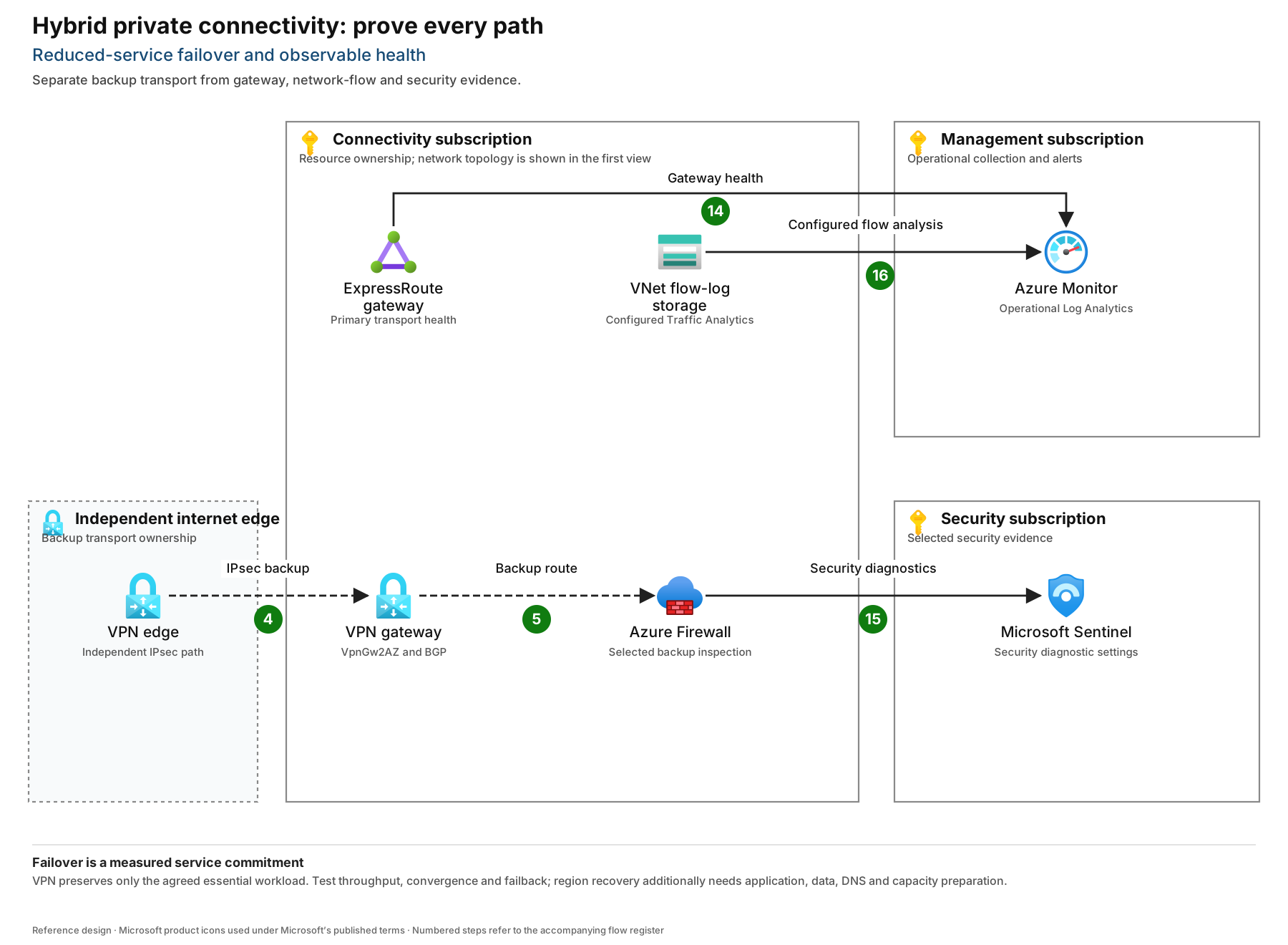
- F4–F5: degraded transport. The VPN advertises the approved backup prefixes. Configure customer-edge preference and verify Azure route selection so ExpressRoute is primary and VPN takes over after route withdrawal. Test both directions and actual failback. Existing sessions can drop; a connected tunnel alone is not evidence of working application recovery.
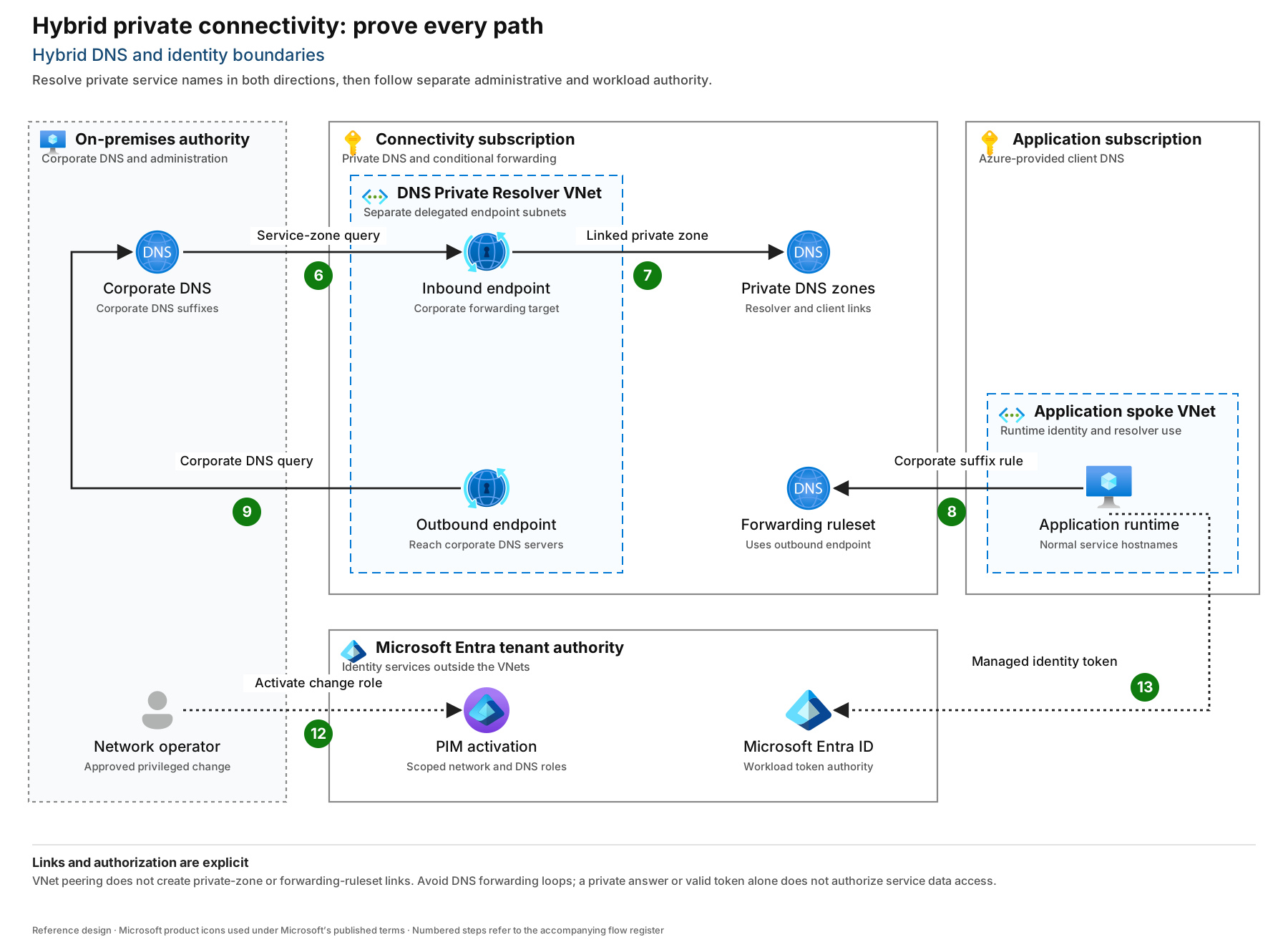
- F6–F7: datacenter DNS to Azure. Corporate DNS conditionally forwards the recommended public service zones to the resolver inbound address. The resolver uses the linked private zones and returns the private endpoint address.
- F8–F9: Azure DNS to corporate services. A forwarding ruleset linked to the application VNet matches the corporate suffix and uses the outbound endpoint to reach corporate DNS. Configure both UDP and TCP 53 reachability and return routing.
- F10–F11: private data access. The application uses its normal Blob or Key Vault hostname and reaches the endpoint NIC. This baseline permits the approved direct private-endpoint path; it does not claim the hub firewall inspects that path.
- F12–F13: authorization. Administrators use the tenant’s privileged access process; the application obtains a token for its managed identity. A valid token without the required resource permission still must not grant data access.
- F14–F16: operations and security evidence. Gateway health and network telemetry reach operations; configured security diagnostics reach the SOC. These exports are independent of the application request path and must be tested separately.
Route selection uses longest-prefix matching before equal-prefix source precedence. A spoke 0.0.0.0/0 UDR therefore does not automatically override a more-specific BGP route. Peering is not transitive; set and test gateway transit, remote gateway use and forwarded-traffic options for the chosen topology. Compare effective routes on the actual workload NIC with the advertised and learned routes on both gateway paths. Azure routing behavior.
DNS and private endpoint failure boundaries
Use Azure-provided DNS on the application spoke, explicit links to the required private zones, and a forwarding ruleset for corporate suffixes. Link the private zones to the resolver VNet for inbound queries. Private-zone links, ruleset links and network peering are separate configurations. Avoid wildcard forwarding and circular rules between corporate DNS and the inbound endpoint. Resolver architecture, resolver endpoint requirements.
For Blob access, forward blob.core.windows.net from corporate DNS and host the endpoint record in privatelink.blob.core.windows.net. Use the documented Key Vault forwarder zones for its actual hostname. Continue using normal service URLs; do not hard-code endpoint IPs or replace application URLs with private-link names. Private endpoint DNS integration, service zone mapping.
If a policy requires private-endpoint inspection, treat it as an additional design. Enable the appropriate endpoint-subnet network policies, install supported sufficiently specific routes, and prove the return path and source-NAT behavior required by the selected inspection topology. A default route alone does not override the endpoint route. Record exactly which endpoint flows are covered. Private endpoint network policies.
TLS inspection additionally needs a compatible client trust configuration and an operated certificate lifecycle; certificate-pinned applications may need a documented exception. Transport encryption, ExpressRoute private peering, Premium TLS inspection and service authorization are not interchangeable controls. Firewall capabilities.
Monitoring and actionable evidence
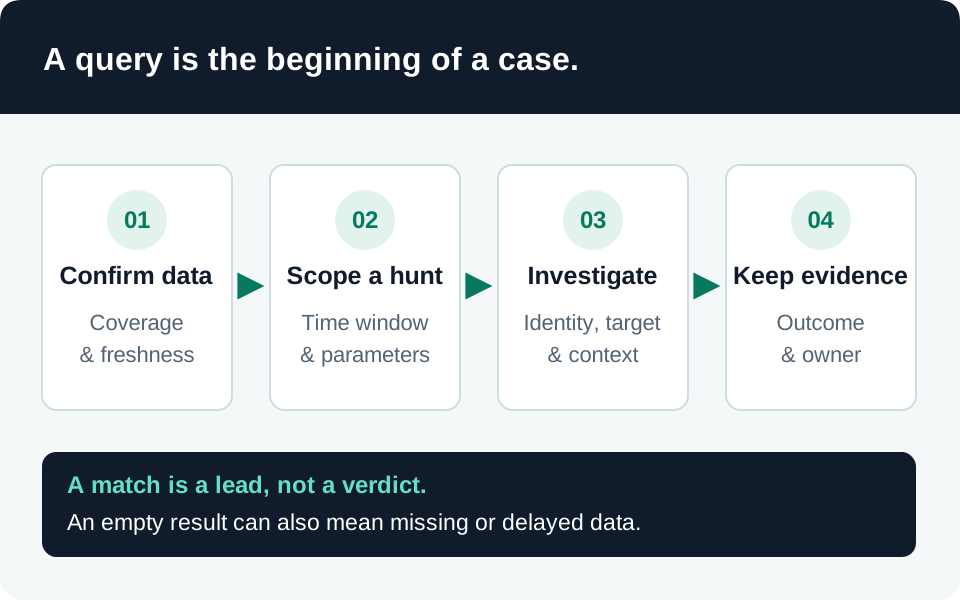
Collect subscription change events, supported gateway diagnostics and metrics, firewall rule logs, and the service access logs needed for investigations. Map each source to an expected table and alert owner. Enable resource diagnostic settings explicitly and distinguish them from guest-agent/DCR collection. Diagnostic settings.
Use VNet flow logs for supported traffic, with storage and analysis configured to meet retention needs. Flow metadata cannot establish the authenticated user or prove TLS payload inspection. Check coverage limitations before accepting a blind spot. Flow-log scope.
Send selected security records to a Sentinel workspace in the approved region; tenant-specific SaaS connectors require their own scope review. Alert separately on tunnel/BGP health, application synthetic failure, DNS failures, unexpected route changes and missing telemetry. A quiet firewall is not proof of no traffic if a route bypasses it. Workspace and tenant considerations.
Rollout and adversarial acceptance tests
Deploy address allocation and telemetry first, then private DNS and one nonproduction endpoint. Establish ExpressRoute and VPN before adding selected inspection routes. Expand one source/destination pair at a time and retain a known-good route and DNS configuration for rollback.
| Controlled test | Acceptance evidence |
|---|---|
| Resolve the same normal service hostname on premises and in Azure | Both approved clients receive the intended private address; resolver and zone ownership are recorded. |
| Call the service with an unauthorized application identity | Data authorization fails despite a working private route. |
| Withdraw the primary advertised path during an approved exercise | The essential transaction succeeds within its agreed recovery window; throughput and dropped sessions are measured. |
| Restore ExpressRoute | Failback follows the intended route preference without sustained asymmetric flows. |
| Attempt an explicitly blocked source/destination pair | Deny is observed at the expected control with no alternate route succeeding. |
| Break a test forwarding rule and stop a synthetic log source | DNS and ingestion alerts reach different accountable owners. |
Recovery, ownership and cost tradeoffs
The network team owns circuit/provider escalation, routes and firewall rollback. DNS administrators own zone/ruleset recovery. The application owner owns retries, reduced-mode behavior and data restoration; the SOC owns evidence continuity. Preserve configuration exports and infrastructure definitions outside the failed workload boundary.
VPN backup is not regional disaster recovery. Regional loss requires a prepared alternate network, DNS/endpoint plan, application capacity and restored or replicated data. Rehearse the complete dependency sequence before promising an RTO; route convergence alone does not restore an application.
Budget separately for provider circuits, ExpressRoute and VPN gateways, firewall uptime and processing, resolver endpoints, peering/data transfer, private endpoints, logs and a recovery region. The backup VPN incurs cost while idle. A single peering location plus VPN costs less than stronger private-circuit diversity but accepts reduced service. Compare those options against measured outage impact and traffic requirements instead of an unsupported fixed monthly estimate.
Trace the design decisions
Microsoft architecture & product guidance
- Microsoft Learn — ExpressRoute with VPN failover reference architecture ↗
- Microsoft Learn — ExpressRoute and site-to-site VPN coexistence ↗
- Microsoft Learn — ExpressRoute virtual network gateways ↗
- Microsoft Learn — VPN gateway SKUs ↗
- Microsoft Learn — Azure virtual network routing ↗
- Microsoft Learn — DNS Private Resolver ↗
- Microsoft Learn — Hybrid DNS architecture ↗
- Microsoft Learn — Private endpoint DNS integration ↗
- Microsoft Learn — Private endpoint DNS zones and forwarders ↗
- Microsoft Learn — Private endpoint network policies ↗
- Microsoft Learn — Azure Firewall SKU features ↗
- Microsoft Learn — Diagnostic settings in Azure Monitor ↗
- Microsoft Learn — VNet flow logs ↗
- Microsoft Learn — Microsoft Sentinel workspace and tenant boundaries ↗