Assumptions to confirm
- West Europe and North Europe are the example paired regions, subject to capacity and residency approval
- The portal is stateless between requests and uses Azure SQL Database for durable order state
- Both regional deployments are provisioned before an incident
- A proposed 30-minute regional recovery target and five-minute data-loss tolerance require business approval and testing
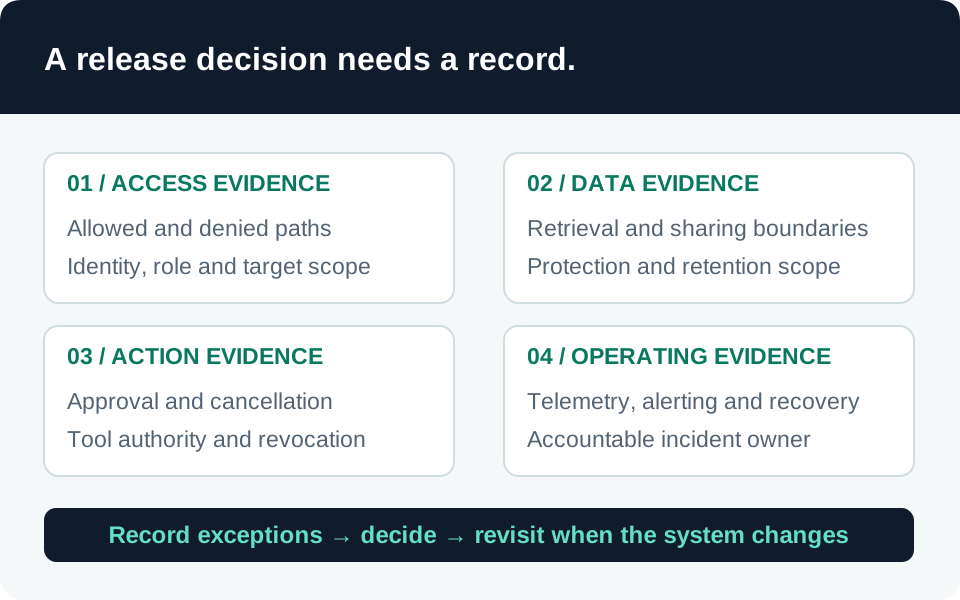
- This is a documentation-reviewed reference design, not a tested recovery guarantee
Use case and recovery contract
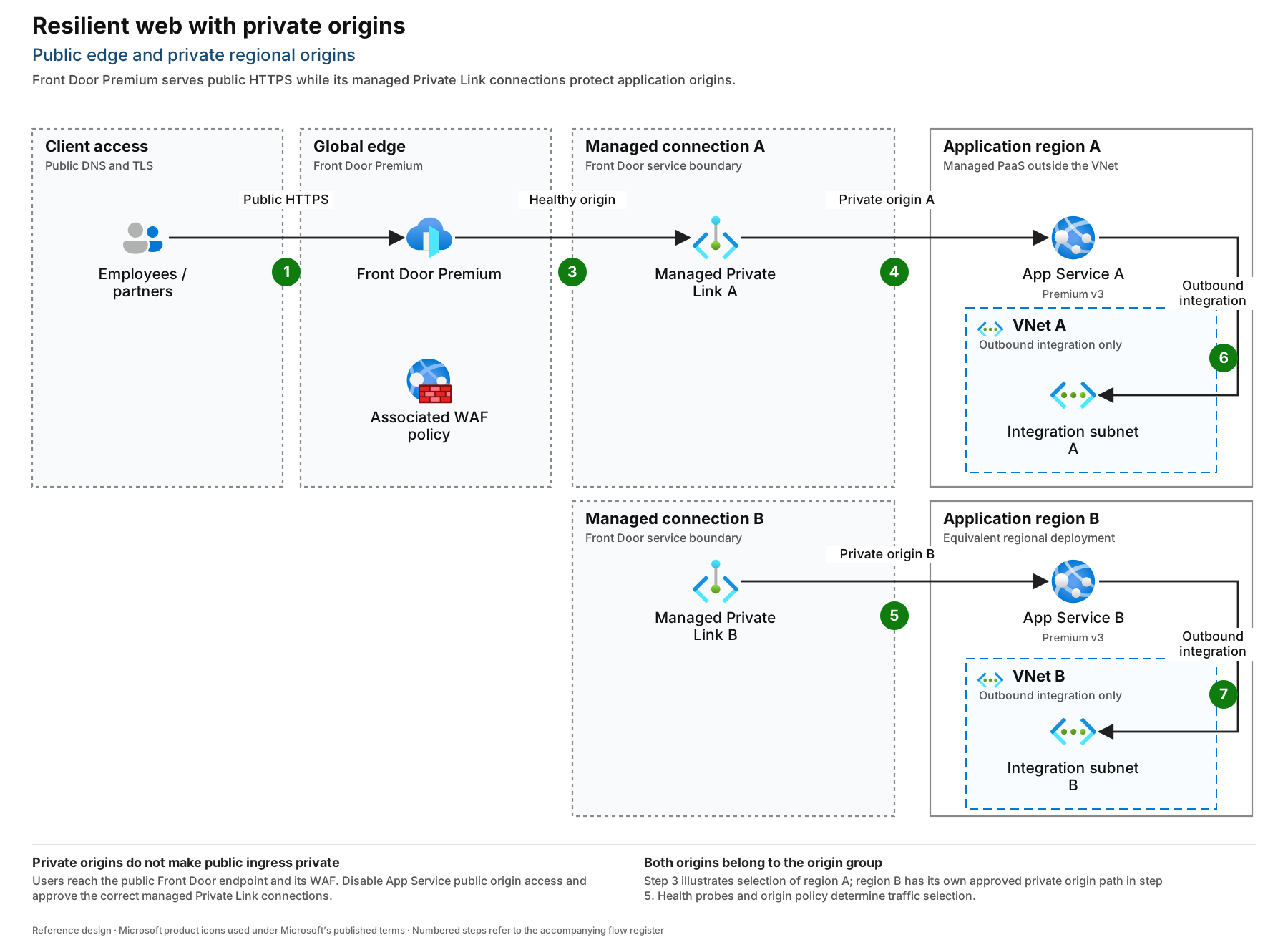
This enterprise order portal serves authenticated employees and partners through public HTTPS. Regional application origins, SQL servers and vaults reject direct public data-plane access. Private origins do not make client ingress private: Front Door remains internet-facing.
Use West Europe as the initial application and database primary, and North Europe as the warm secondary. Propose a 30-minute regional recovery objective and a maximum five-minute business tolerance for lost orders as workshop inputs, not service guarantees. If the business cannot lose acknowledged orders, asynchronous database replication alone is insufficient; revise the transaction and recovery design before approval.
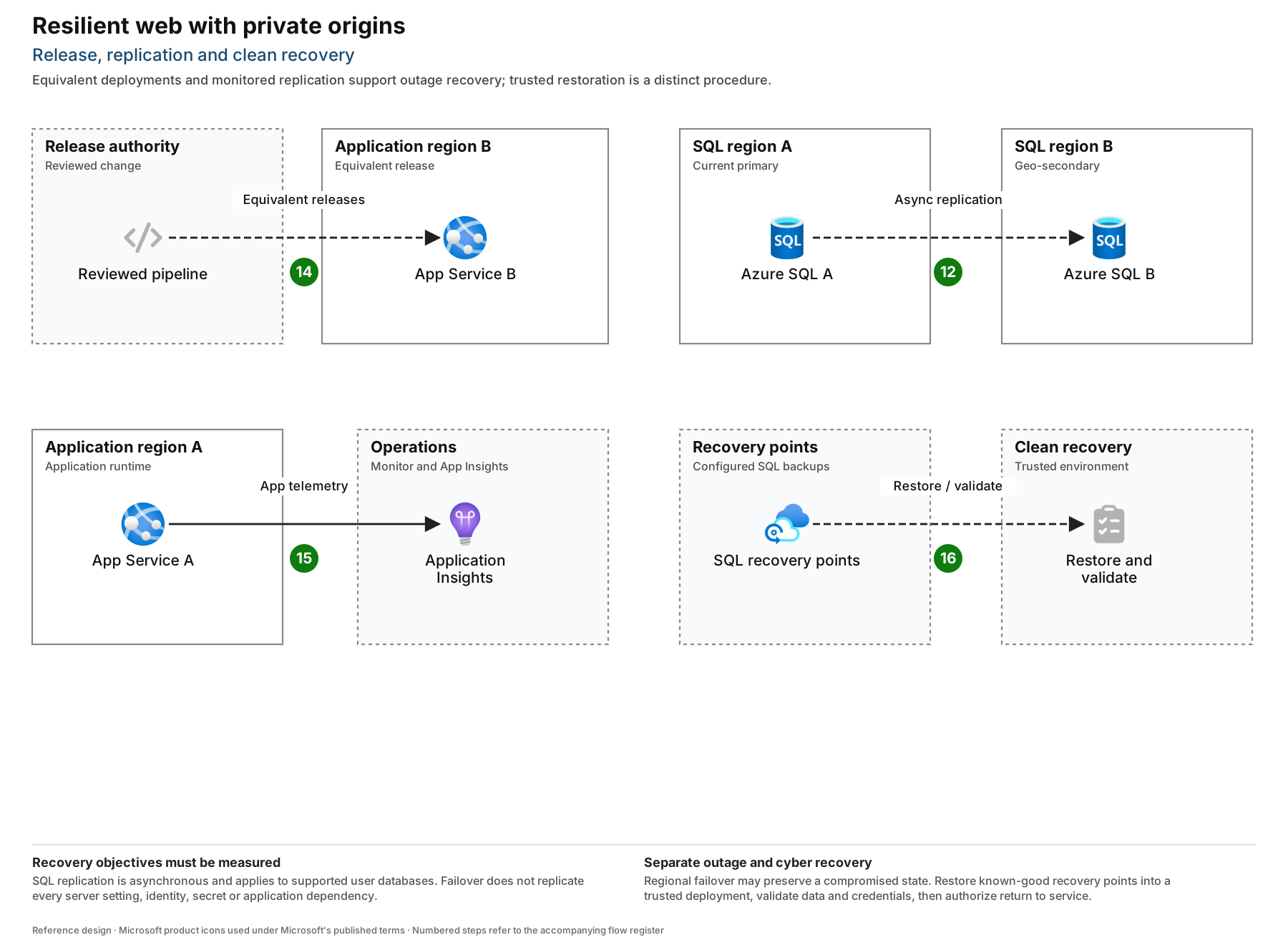
Regional outage recovery moves service to healthy infrastructure. Cyber recovery establishes a trusted application, identity configuration and clean dataset. Replication can copy malicious writes and deletions, so these are separate runbooks.
Component and control matrix
| Component | Selected baseline | Decision and owner |
|---|---|---|
| Global ingress | Front Door Premium with WAF policy | Edge team owns domains, TLS, rule tuning and origin approval |
| Regional web tier | App Service Premium v3, initially P1v3 and at least two instances per region | Application team load-tests capacity; enable zone redundancy where the region and scale unit support it |
| Origin connectivity | Front Door managed Private Link endpoint per region | Network team approves only expected connections and disables public origin access |
| Outbound application network | Regional VNet integration in a delegated subnet | Network team maintains separate integration and private-endpoint subnets |
| Database | Azure SQL Database General Purpose, provisioned compute, matching regional capacity and a failover group | Database owner selects compute from tests and approves every forced failover |
| Secrets and identities | Regional managed identities and regional Key Vaults | Identity owner limits permissions; application team manages equivalent configuration |
| Name resolution | Shared SQL Private DNS zone linked to both VNets; regional vault records | Network team tests both directions and failover listener resolution |
| Observability and backups | Application Insights, platform metrics, selected resource logs and documented SQL backup retention | Operations owns alert delivery; recovery owner proves restore usability |
Premium v3 enables the selected App Service capabilities, but availability-zone support also depends on the actual scale unit. Provision sufficient warm capacity: autoscaling during an outage is not reserved capacity. App Service reliability constraints.
Trust and network boundaries
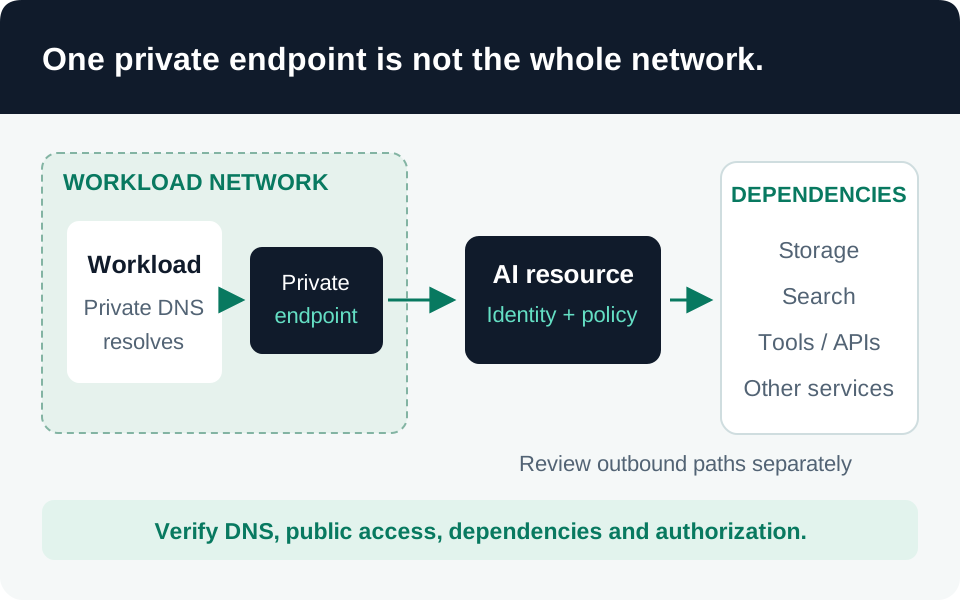
Front Door Premium creates its origin private endpoints in Microsoft-managed regional networks, outside the application’s VNets. Approve each connection on its intended App Service resource, configure the correct origin hostname and certificate validation, then verify public access is disabled. Use different supported Private Link regions for the two origins. App Service deployment slots are not supported as Front Door Private Link origins; this design routes to two production apps, not slots. Front Door Private Link support and web-app setup.
App Service remains a managed PaaS service outside the VNet. Its private endpoint is inbound connectivity; VNet integration is outbound connectivity. Put integration and private endpoints in separate subnets. This example uses peered regional VNets so either application can reach either SQL private endpoint during application-only or database-only failover. Define and test the required routes and network controls rather than assuming DNS provides connectivity. Inbound private endpoints and outbound VNet integration.
No Application Gateway is required for this direct Front Door-to-App Service pattern. Add another proxy only for a specific requirement and account for its operational and recovery dependencies.
Numbered request, identity and recovery flows
- F1 — Public ingress. Public authoritative DNS points the portal hostname to Front Door. HTTPS requests encounter the associated WAF policy before origin routing; authenticated responses are not publicly cached.
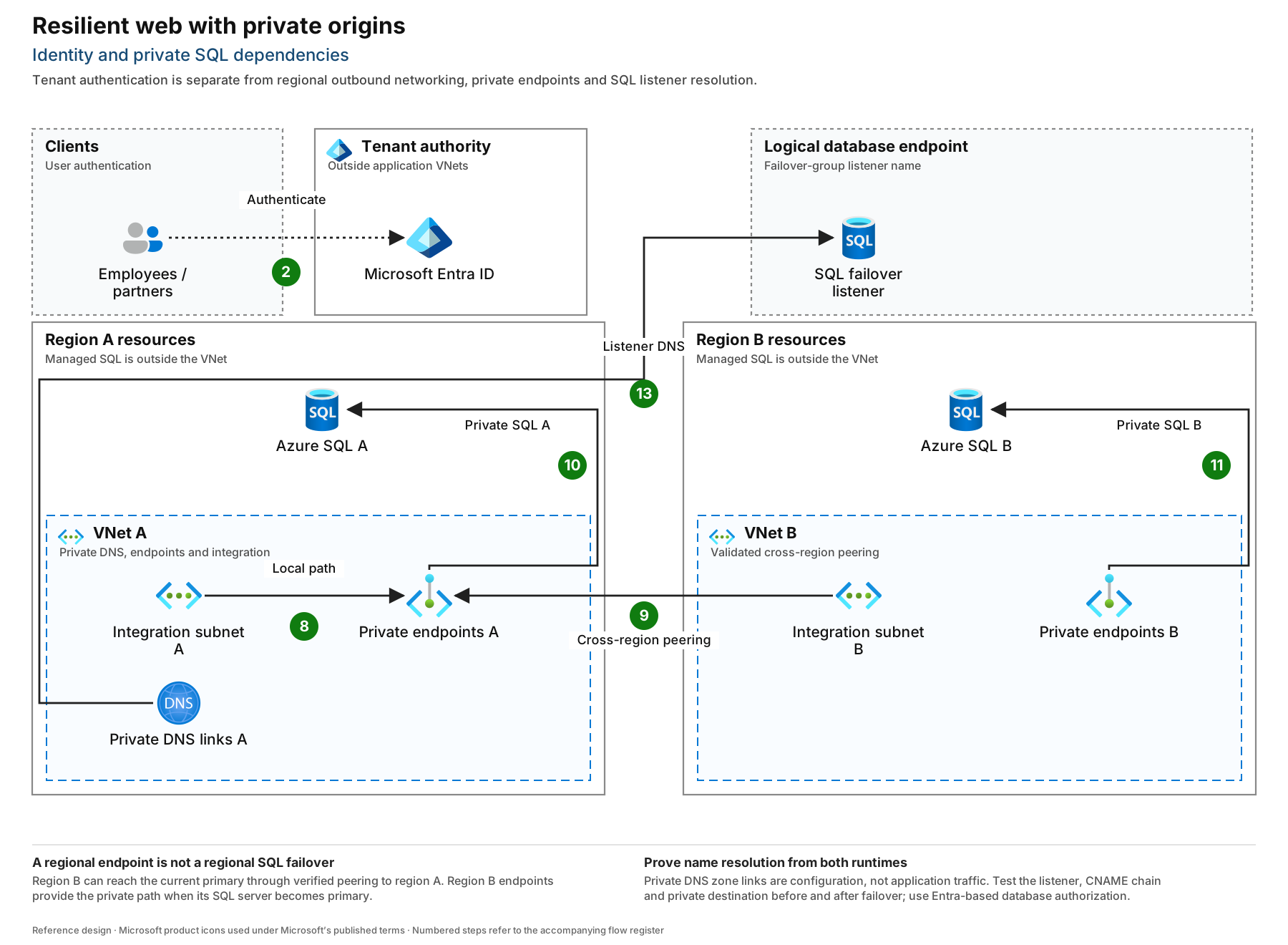
- F2 — User authentication. The portal uses Entra authentication and application authorization. Authentication traffic is distinct from the Private Link path; WAF does not authorize access to orders.
- F3 — Origin selection. Front Door selects the healthy primary origin, with the secondary at lower priority. Each origin has its own approved regional Private Link connection.
- F4 — Primary inbound path. The primary managed endpoint forwards HTTPS to the West Europe production app. Origin host and TLS configuration must match.
- F5 — Secondary inbound path. The North Europe managed endpoint reaches the secondary production app without reopening public origin access.
- F6 — Primary outbound path. The primary app uses its delegated VNet integration subnet to reach private dependencies.
- F7 — Secondary outbound path. The secondary app has an independently configured integration subnet and tested dependencies before it receives users.
- F8 — Regional dependency routing. Primary integration traffic reaches approved SQL and vault private endpoints; explicit egress policy covers other required application dependencies.
- F9 — Cross-region dependency routing. The secondary VNet can reach the primary SQL endpoint over peering. Test the reverse path too; application and database primaries need not move together.
- F10 — Primary data access. The private SQL endpoint delivers connections to the primary logical server. Vault access uses its separate endpoint and permissions, not the SQL endpoint.
- F11 — Secondary data access. The secondary SQL endpoint provides the corresponding path after database failover. Its vault and managed identity remain independently provisioned.
- F12 — Database replication. The failover group asynchronously replicates selected user databases to the other logical server. This is a managed service path, not traffic forwarded through the app integration subnet.
- F13 — Listener resolution. Applications use the failover group’s read/write listener hostname. DNS follows the current primary and resolves its private endpoint using the shared SQL private zone.
- F14 — Consistent deployment. A reviewed pipeline deploys the same immutable application artifact and compatible configuration to both regions. Deployment authority is separate from runtime identity.
- F15 — Telemetry. Both applications emit redacted request, dependency and exception telemetry; platform metrics and resource logs complement it.
- F16 — Clean recovery. The recovery team restores an approved backup into a separately assessed recovery deployment and validates integrity before changing production routing.
SQL, DNS and identity decisions
Follow the documented paired-region Private Link setup: nonoverlapping VNets, a private endpoint for each logical SQL server and reuse of the SQL private DNS zone. Link that zone to both application VNets. Use the listener FQDN in connection strings; never pin the active primary’s address in application configuration. Test actual application resolvers, connection pools and retry behavior after a role change. Failover group configuration.
Choose customer-managed failover for this design. Microsoft-managed failover targets qualifying widespread outages; it is not a substitute for an application recovery decision. Planned failover and forced failover have different data-loss implications. Monitor replication lag, but do not convert a recent healthy sample into a guarantee about unreplicated transactions when the primary becomes unreachable. Failover group behavior.
Replicate application data, not assumptions about server configuration. Provision and verify both servers’ Entra administration, access configuration, endpoints and monitoring separately. Review database users and cross-database dependencies; selected database replication does not replicate the surrounding application stack. Active geo-replication scope.
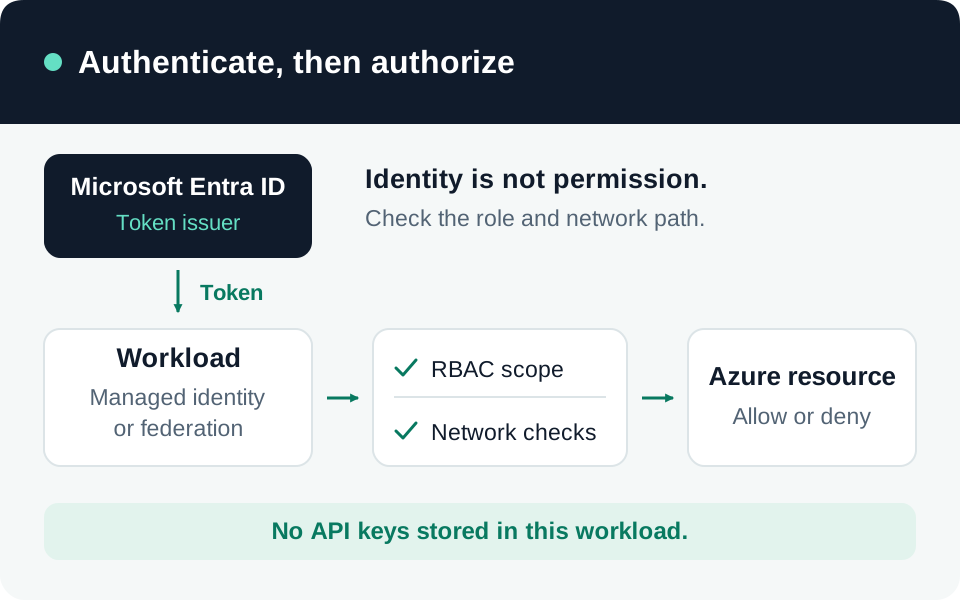
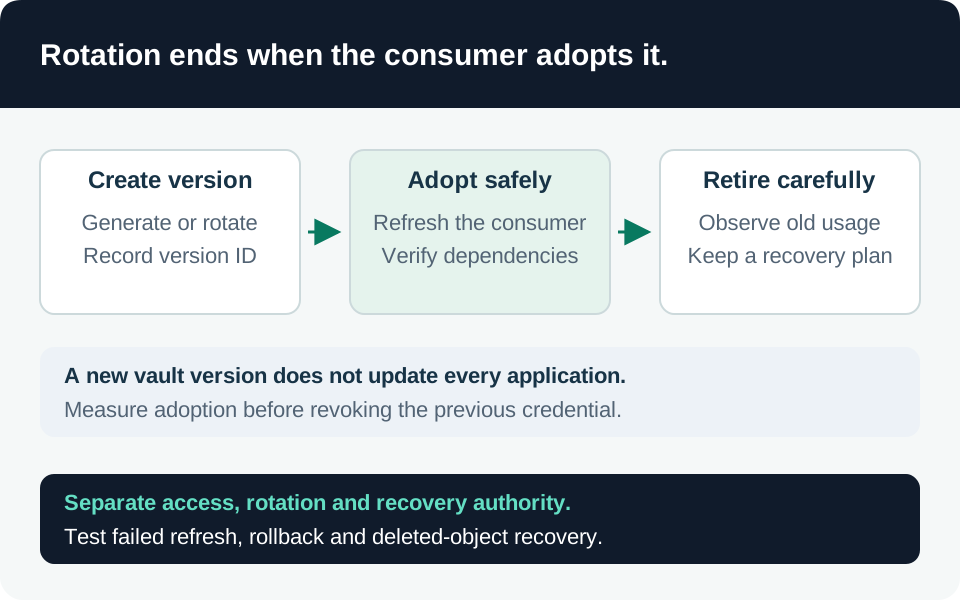
Prefer managed identity to stored SQL passwords. Give each region only its required database permissions and vault access. Regional vault contents are deliberately provisioned and rotated; two vaults are not automatically synchronized. For Linux App Service accessing network-restricted Key Vault references, configure the documented VNet routing. References can cache values for up to 24 hours, so rotation tests must include refresh behavior. Key Vault reference networking and rotation.
Health probes and failure tests
Use a lightweight readiness endpoint that returns HTTP 200 only when the app can serve the intended transaction class. Avoid creating orders or exposing diagnostics from this endpoint. Front Door expects 200 for a healthy probe; if all origins are unhealthy, it can still distribute requests across them. Therefore each app must fail safely with an appropriate unavailable response when required dependencies are down. Front Door probe behavior.
| Acceptance test | Evidence and failure response |
|---|---|
| Request each default App Service hostname from an external network | Direct public origin access is denied while the portal remains usable |
| Remove one approved Private Link connection in a test environment | Traffic moves through the other region without a public-origin workaround |
| Stop only the primary app | Secondary app reaches the still-primary database over the tested private path |
| Perform a planned SQL failover | Both regional apps reconnect using the unchanged listener; committed test orders remain consistent |
| Simulate total dependency failure | Apps return controlled errors; no unsafe write or authentication bypass occurs |
| Load-test the secondary alone | Measured throughput and latency meet the approved recovery service level |
| Revoke a test identity permission or rotate a test secret | Failure is visible and recovery does not require broad privileges |
| Restore a known clean backup | Schema, business invariants and access controls are verified before promotion |
Monitoring, recovery ownership and rollout
Monitor external transaction success, Front Door origin health, WAF blocks, App Service saturation, SQL replication state, connection errors, vault denials and diagnostic-setting drift. Exclude tokens, raw order payloads and secrets from telemetry. Alerts need tested recipients and an independent service-status channel. The related hunts support selected configuration and identity checks; they are not an availability test suite.
The incident commander chooses application traffic moves; the database owner authorizes forced database failover and records possible data loss. Freeze deployments, preserve the incident timeline, verify the surviving region’s dependencies, then measure recovery from the user’s perspective. Control failback deliberately: an origin becoming healthy can make it eligible for traffic again. Keep both regions on compatible application and schema versions. Multi-region deployment considerations.
For compromise, identify a clean point and rebuild trusted configuration before promotion. SQL point-in-time restore creates a new database and has documented location restrictions; it is not an arbitrary cross-region clean-room restore command. Geo-restore requires appropriate backup redundancy, and long-term retention only helps if a suitable backup already exists. Select and rehearse the applicable path instead of assuming the live secondary is clean. Backup restore options and ransomware recovery.
Roll out private DNS and identities first, then each regional app, database replication, the secondary transaction test, and finally public edge traffic. Protect deployment access separately: a private SCM endpoint and reachable controlled runner are required if deployment uses private SCM; Front Door’s managed endpoint is not a deployment network.
Cost and complexity tradeoffs
The price of warm regional recovery is duplicated App Service and database capacity, Front Door Premium, private endpoints, cross-region traffic, backups and monitoring. A smaller secondary lowers steady-state cost but creates capacity risk and a slower recovery dependency. Zone redundancy addresses a different failure boundary from a second region. Optimize measured instance size, telemetry volume and retention after proving acceptance tests; do not remove the tested recovery path merely because the secondary is usually quiet.
Trace the design decisions
Microsoft architecture & product guidance
- Secure Azure Front Door Premium origins with Private Link ↗
- Connect Front Door to an App Service origin with Private Link ↗
- Azure Front Door health probes ↗
- App Service private endpoints ↗
- App Service virtual network integration ↗
- Reliability in Azure App Service ↗
- Multi-region App Service architecture ↗
- Azure SQL Database failover groups ↗
- Configure a SQL Database failover group ↗
- Active geo-replication in Azure SQL Database ↗
- Use Key Vault references in App Service ↗
- Restore Azure SQL databases from backups ↗
- Recover Azure SQL Database from ransomware ↗