Intelligence assessment
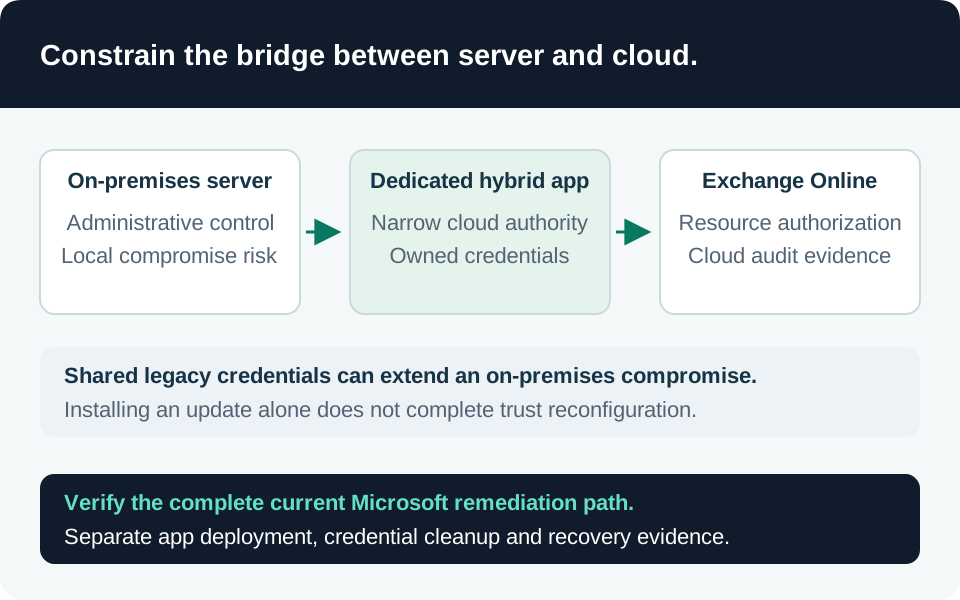
CVE-2025-53786 crosses an identity boundary: an attacker who already controls an on-premises Exchange server as an administrator may abuse shared hybrid trust to elevate access in the connected cloud environment. It is not an unauthenticated initial-access vulnerability. Microsoft’s advisory warns that the resulting activity might not leave easily detectable and auditable traces. MSRC advisory.
Microsoft’s 11 August 2025 guidance reported no observed active exploitation at that time. That dated statement does not establish the exploitation status on 13 November 2026. This dossier therefore uses Vendor advisory, not an invented campaign attribution. Dated MDVM guidance.
The recommended control is a complete trust transition or retirement, with evidence of cleanup. Where rich coexistence is required, installing supporting software does not prove the dedicated app is enabled, and creating the app does not prove obsolete credentials were removed. Where that functionality is no longer needed, do not create a replacement privileged application merely to remove old trust.
Scope and current support position
The advisory’s affected-product inventory includes Exchange 2016 CU23, Exchange 2019 CU14/CU15, and Exchange Server Subscription Edition RTM. Subscription Edition includes the dedicated-app feature, but required rich coexistence still needs configuration and cleanup of the shared service principal’s old credentials. Previously hybrid organizations also need to assess residual trust, even when no mailboxes remain on premises. MSRC applicability and actions.
An organization using only Exchange Online, with no present or historical on-premises hybrid trust, does not have this specific precondition. Do not classify a tenant as cloud-only solely because its mailbox migration finished: verify credentials, applications, servers, and actual hybrid dependencies.
Exchange 2016 and 2019 reached normal end of support on 14 October 2025. Microsoft’s October 2026 update announcement states that subsequent security updates are for Subscription Edition; testing of 2016/2019 for newly discovered vulnerabilities also ends. An absent future CVE listing for those old versions is not evidence of immunity. End of support, October 2026 servicing position.
Trust boundary and failure mode
The security concern is the authority attached to a credential, not simply its presence on disk. A compromised on-premises server may possess material that a shared cloud identity trusts. Replacing that relationship with a dedicated application constrains the intended hybrid connection; removing the previous relationship closes a separate route.
Build an explicit map: on-premises server, certificate owner, application registration, enterprise application/service principal, approved permissions, and cloud service dependency. Application IDs and service-principal object IDs identify different objects; mixing them in an investigation can conceal the actual credential owner. Treat a map with unresolved identities as incomplete evidence, not an administrative inconvenience.
Ordered hardening procedure
- Inventory and select the required branch. Identify servers, builds, tenant connections, certificates and business functions, including dormant migration environments. Establish whether rich coexistence such as Free/Busy, MailTips or profile pictures is still needed. SMTP relay or recipient management alone does not require the dedicated app. Agree on a maintenance window and an independent recovery contact. Scenario-specific requirements.
- Maintain supported software without delaying cleanup-only work. Run the current Exchange Health Checker and review updates and known issues. The April 2025 hotfix was a historical feature prerequisite, not a November 2026 baseline. Microsoft explicitly permits shared-principal cleanup without that hotfix when rich coexistence is unnecessary: proceed to step four while separately addressing unsupported servers. Capture post-update builds and restarts. Servicing guidance, cleanup-only prerequisite.
- For required rich coexistence, deploy and enable the dedicated app. Follow the current workflow for the participating Exchange organizations and tenants, using the required permissions. Current Graph support begins with the May 2026 hotfix and is available in Microsoft 365 Global only; check cloud, build and scenario availability before enablement. Unsupported clouds can lose hybrid functionality if Graph flow is enabled. Skip app creation for the cleanup-only branch. Deployment and cloud availability.
- Remove obsolete shared credentials in both branches. For continuing coexistence, complete the supported dedicated-app transition first. For retired or unnecessary rich coexistence, run the documented service-principal cleanup directly; do not create an app as a prerequisite. Verify the resulting credential state. The Hybrid Configuration Wizard does not perform cleanup automatically, and its OAuth-related configuration can upload a certificate again. Recheck after wizard changes. Cleanup and wizard behavior.
- Validate the functions you retain. Test the business functions from step one, including relay or management where applicable. Graph integration still uses EWS for some scenarios; retain required EWS permissions. Shared-principal EWS access has been blocked since 31 October 2025, so restoring old trust is not a supported rollback. If rich coexistence has ended, assess deletion of an existing unnecessary dedicated app using Microsoft’s documented mode; this does not automatically revert on-premises settings. Compatibility and retirement guidance.
- Reduce the prerequisite risk. Restrict Exchange administrative access, separate daily and privileged identities, review remote administration paths, and monitor changes to trust material. The dedicated app does not make an already compromised server trustworthy.
Investigation and detection limits
Start with the earliest plausible on-premises administrative compromise, not just the time the cloud alert appeared. Preserve server activity, certificate inventory, administrative changes, application permissions, available Entra audit/sign-in records, and Exchange configuration evidence. Document collection times and retention boundaries.
Use the linked application credential changes, service-principal credential change/sign-ins, and application consent grants queries to organize supporting evidence. They are generic identity hunts, not CVE-2025-53786 signatures. Verify their source tables, operation names, entity mapping, and lookback before use. A credential change might be routine administration; an attacker using an existing credential might create no new credential-change event.
Compare every relevant application and permission against an approved baseline. Identify the operator, change ticket, source system, credential validity, and subsequent use. Investigate unexplained drift separately from expected deployment changes. Because the vendor warns about audit limitations, clean query results cannot substitute for examination of compromised servers and the actual trust configuration.
Recovery after suspected abuse
Contain the compromised administrative path and preserve evidence before rebuilding affected servers. Use a clean administrative workstation and establish trustworthy operator identities. Assess potentially exposed certificates, secrets, privileged accounts, and cloud changes with the incident lead. Remove unauthorized grants and persistence, then rotate affected credentials through their documented owners.
Do not assume dedicated-app deployment revokes every existing session or unrelated credential. Define recovery by verified access and configuration outcomes, with an explicit list of unresolved investigation gaps. Reintroduce hybrid functions in controlled stages and require successful monitoring checks after each stage.
Verification matrix
| Control | Evidence to retain | Failure condition |
|---|---|---|
| Supported software | Current Health Checker output and server inventory | Retired server still participates |
| Trust branch | Required coexistence has approved app and enablement; cleanup-only has no unnecessary replacement app | App missing where required, or created without a business need |
| Shared-credential cleanup | Post-cleanup object inspection | Old authentication certificate remains trusted |
| Functional recovery | Scenario-specific test results | Only mailbox sign-in was tested |
| Change durability | Check after wizard runs and certificate changes | Trust is silently recreated |
Dated timeline
| Date | Verified development |
|---|---|
| 18 April 2025 | Microsoft announced the hybrid security changes later referenced by the CVE. |
| 6 August 2025 | CISA’s public alert identified CVE-2025-53786 and the required configuration work. |
| 11 August 2025 | Microsoft published its dated MDVM guidance. |
| October 2026 | Final announced extended security updates for Exchange 2016/2019. |
| 13 November 2026 | This documentation review checked current deployment and servicing guidance. |
The first-public-report date above follows CISA’s original bulletin; later advisory revisions should not be mistaken for initial disclosure.
Trace the evidence