
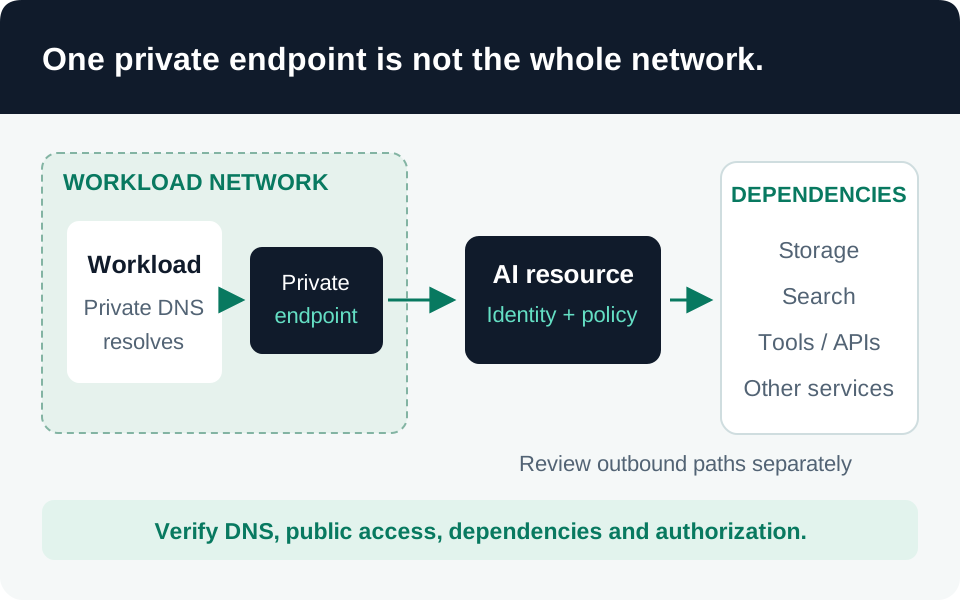
Private access to the model endpoint addresses one connection. The agent can still retrieve data, invoke a remote tool, fetch a package, or send telemetry through different paths. Build the network design from actual communicating processes and destinations. This guide proposes an evidence-driven design; it does not claim that a particular tenant or hosted runtime has passed these tests.
Separate four traffic planes
Document client-to-service traffic, service-to-dependency traffic, administration/deployment traffic, and telemetry traffic. For each connection record the executing runtime, destination hostname, protocol, required authentication, route, name-resolution path, and owner. Include worker jobs, evaluators, hosted tools, and recovery environments.
Foundry provides distinct inbound and outbound isolation configurations. Its current documentation describes customer-managed network injection and managed networking; availability and constraints depend on the resource, region, agent type, and deployment generation. Hosted agents are identified as preview in the networking guidance. Pin the selected deployment model before copying a reference architecture. Foundry network isolation.
Our threat model includes a malicious retrieved URL, an overly broad external-tool destination, a public DNS fallback, and a deployment that can rewrite egress rules. Network controls reduce reachable destinations; they do not validate whether an authorized API request is appropriate for the user.
Choose an outbound policy that matches the risk
The managed network offers internet-allowed and approved-outbound modes, among other configuration states. Approved outbound can use private endpoints, service tags, and FQDN rules. FQDN rules can provision a managed Azure Firewall, creating a material cost dependency; its SKU selection and mode transitions have documented restrictions. Review these before deployment rather than treating a checkbox change as reversible. Managed-network modes and limits.
For sensitive agents, our recommended destination register distinguishes platform dependencies from business tools. Give each external tool a specific owner, purpose, expected methods, credential scope, and review date. Prefer a narrow adapter for an API requiring broad internet infrastructure. An allowlist such as all cloud storage domains is weak protection against sending data to someone else’s account on the same service.
Do not use a NAT gateway as evidence of destination filtering. Stable source addressing and outbound authorization solve different problems. Check the runtime’s actual route through the chosen enforcement point, including any platform-managed traffic outside your customer subnet.
Make DNS an explicit part of the control
Keep normal service hostnames in application configuration and resolve them to the intended private endpoints from each client network. Centralize the required private zones and link the networks that need them. Creating duplicate private zones with the same name in separate spokes makes record consistency an operational problem. DNS integration patterns.
For on-premises clients, a Private Resolver inbound endpoint provides a reachable forwarding target. An outbound endpoint serves the opposite direction, forwarding Azure queries toward configured external resolvers. These roles are not interchangeable. Private Resolver behavior.
Use the documented service-specific public-zone forwarding entries so the CNAME chain reaches the private zone correctly. Do not point an on-premises resolver directly at Azure’s virtual resolver address and expect it to be reachable across the internet. Validate from the actual agent subnet and evaluator runtime as well as from an administrator’s laptop. Agent networking DNS matrix.
Test the request path, not only name resolution
For a permitted call, capture resolved address, destination, TLS hostname validation, resource identity, operation, and result. A private address proves a DNS outcome, not successful authorization. A 403 can arise after a valid network connection; investigate the service’s authentication and authorization evidence before adding broad firewall exceptions.
For a denied call, use a harmless destination you control and a synthetic payload. Confirm the egress enforcement point records the denial and the application reports a controlled failure. Then test a redirect from an approved endpoint to a disallowed destination. Our application recommendation is to validate every redirect and resolved destination according to the tool’s contract, including private-address restrictions where tools fetch arbitrary URLs.
| Failure case | Expected evidence |
|---|---|
| DNS zone missing from one client network | Test fails visibly; no silent public fallback is accepted |
| Allowed endpoint and valid identity | Intended operation succeeds through the approved path |
| Allowed endpoint and unauthorized identity | Resource rejects the operation |
| External destination outside the register | Enforced denial from the actual execution runtime |
| Tool redirects to another destination | Adapter reapplies destination policy |
| Public access disabled | External access fails while the required private path remains usable |
| DNS resolver or inspection service unavailable | Defined failure behavior and recovery procedure work |
Operate the boundary over time
Review denied destinations before expanding an allowlist. Distinguish a newly required platform dependency from a tool attempting an unexpected transfer. Version the destination register with the application release, and require evidence when a model/tool update changes network behavior.
Measure resolver availability, route drift, private-endpoint approval state, and denied connection trends. Keep a recovery route that restores necessary service without opening unrestricted outbound traffic. Pair these controls with tool trust boundaries and storage authorization: a private connection to an overprivileged tool remains an overprivileged connection.
Go to the source